

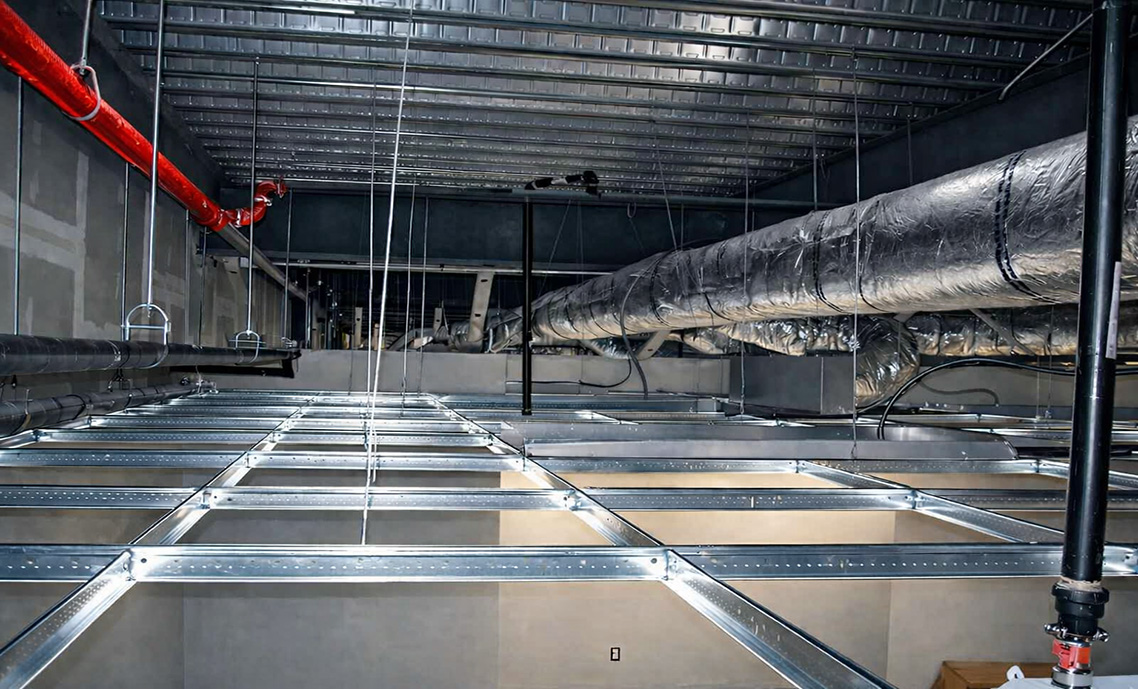
The Great Ceiling Divide
With these fundamentals established, let’s delve into the key details and questions that will ensure your designs meet both safety and regulatory standards.
Definitions & Classification
1. What is the difference between plenum space and air handling space?
The difference lies in their function within a building’s HVAC system. NEC 300.22(C) defines a plenum as “a compartment or chamber to which one or more air ducts are connected and that forms part of the air distribution system.” NFPA 90A also defines plenums and governs their construction and fire-resistance requirements. Air handling spaces fall under NEC 300.22(B) and 300.22(D) and refer to “other spaces used for environmental air,” such as the space above a suspended ceiling or beneath raised floors for IT equipment. While both involve air movement, plenums are enclosed and directly tied to the HVAC system, whereas air handling spaces are more ambient and less regulated. Environmental air is defined in NEC Article 100.
2. What is a plenum space?
A plenum is a compartment or chamber that is part of the air distribution system, typically used for air return in HVAC systems. It is a designated space where air is actively moved for heating, ventilation, and air conditioning before being redistributed. NFPA 90A also governs plenum construction and fire-resistance requirements. Because air flows freely in these areas, any fire or smoke can spread rapidly, making fire-resistant materials essential. CMP cable is required in plenum spaces per NEC 300.22(C).
3. What is an air handling space?
An air handling space refers to areas used for environmental air circulation but not specifically designed as plenums. Examples include the space above a suspended ceiling or beneath raised floors used for IT equipment. These spaces fall under NEC 300.22(B) and 300.22(D). While not enclosed chambers like plenums, they still carry environmental air and require materials listed for use in environmental air, such as UL 2043–compliant components.
4. Is an under‑floor space considered a plenum or an air handling space?
An under‑floor space is classified based on how it is used within the HVAC system. If the raised‑floor cavity is intentionally used to move environmental air as part of the building’s air distribution system, it is treated as an air handling space under NEC 300.22(B) and 300.22(D). If the space is designed as part of the return‑air path or forms part of the HVAC air distribution system, it may be classified as a plenum under NEC 300.22(C) and NFPA 90A. If no environmental air is circulated through the space, it is considered neither a plenum nor an air handling space. Classification depends entirely on HVAC design and must be verified through building plans and AHJ interpretation.
5. Why are air handling and plenum spaces often confused?
Many installers and specifiers assume any drop ceiling is a plenum even when it does not meet NEC or NFPA 90A definitions. This misclassification leads to incorrect material selection, failed inspections, and fire safety risks. Clarifying the space type is essential before installation.
6. How do I know if a ceiling space is classified as plenum or air handling?
Determining whether a ceiling space is a plenum or air handling space involves reviewing building plans and HVAC system designs. The Authority Having Jurisdiction (AHJ) should also be consulted for local code interpretations. Plenums are enclosed compartments forming part of the air distribution system (NEC 300.22(C)), whereas air handling spaces are areas used for environmental air circulation (NEC 300.22(B) and (D)). NFPA 90A may also apply depending on the system design. Proper classification is crucial for selecting appropriate materials and ensuring code compliance.
Fire & Safety Requirements
7. What are the potential fire safety risks in plenum spaces?
Plenum spaces pose a higher fire risk because they allow smoke and flames to travel quickly throughout a building. Materials installed in plenum spaces must be plenum-rated to meet strict fire safety standards, ensuring low smoke emission, flame resistance, and minimal toxic fumes. CMP cable is required, and non–plenum-rated materials can accelerate fire spread and compromise occupant safety.
8. What are the potential fire safety risks in air handling spaces?
Air handling spaces also require fire-resistant materials, though they are regulated differently than plenums. NFPA 90A requires that materials exposed to airflow meet low-smoke and heat-release criteria. Components must comply with UL 2043, which tests for heat and smoke release. While the risk is lower than in plenums, non-compliant materials can still pose serious hazards.
Code‑Driven Material Requirements
9. What materials are approved for use in plenum spaces?
Materials used in plenum spaces must meet strict fire safety standards because these areas allow air—and potentially smoke or flames—to spread rapidly. CMP-rated cables must comply with NFPA 262 (tested using the UL 910 Steiner Tunnel method). Low-smoke PVC and FEP are common plenum cable jacket materials. Metal conduit is frequently used to enclose cables that are not plenum-rated. Nonmetallic raceways are only permitted if they are specifically listed and marked for plenum use per NEC 300.22(C). All materials must comply with NEC 300.22(C) and be UL-listed for plenum applications. CMR should not be used unless the AHJ explicitly approves it in writing prior to installation.
10. What is UL 2043 and why does it matter in air handling spaces?
UL 2043 is a fire safety standard that measures the heat and smoke release of discrete products installed in air handling spaces. These include nonmetallic boxes, enclosures, cable management accessories, and similar components. UL 2043 compliance ensures that materials will not contribute significantly to fire spread in environmental air spaces governed by NEC 300.22(B) and (D).
11. What is UL 910 and how does it differ from UL 2043?
UL 910 is the Steiner Tunnel test method used within NFPA 262 to evaluate flame spread and smoke density for plenum-rated cables (CMP). UL 2043 evaluates the heat and smoke release of discrete products used in air handling spaces. UL 910 applies to cable jackets in plenum environments, while UL 2043 applies to accessories and components in environmental air spaces.
12. What does NFPA 90A require for materials in air handling spaces?
NFPA 90A sets fire safety requirements for materials exposed to airflow in HVAC systems, including air handling spaces. Materials must be noncombustible or meet specific limits for flame spread and smoke development—typically a flame spread index of 25 or less and a smoke developed index of 50 or less. These thresholds apply to wiring, tubing, diffusers, and small components like cable ties. Compliance ensures materials will not contribute to fire growth or smoke hazards in environmental air spaces.
13. How do cable requirements differ between plenum and air handling spaces?
Plenum areas require CMP-rated cables tested to NFPA 262 (UL 910 method). Air handling spaces may allow UL 2043–compliant components, but cable jackets must still meet appropriate fire resistance requirements. CMR cable is not automatically permitted in air handling spaces and may only be used if the AHJ explicitly approves it. CMR should not be used unless the AHJ explicitly approves it in writing prior to installation.
14. Can riser-rated cables be used in air handling spaces?
Riser-rated cables (CMR) are designed for vertical shafts between floors and are not automatically approved for use in air handling spaces. Unless the space is explicitly classified as a riser and not exposed to environmental air circulation, CMR cables may fail inspection. Always confirm with the AHJ and refer to NEC 300.22(B) and (D). CMR should not be used unless the AHJ explicitly approves it in writing prior to installation.
15. Do cable ties and accessories need to be plenum- or UL 2043-rated?
Cable ties, fasteners, mounting bases, straps, and hook and loop installed in plenum or air handling spaces must meet fire safety standards. For plenum use, accessories must be plenum-rated or enclosed in metal conduit. For air handling spaces, UL 2043 compliance is required to limit heat and smoke release. Straps and hook and loop installed in plenum or air-handling spaces must be plenum-rated or UL 2043-compliant. CMR should not be used unless the AHJ explicitly approves it in writing prior to installation.
Common Field Errors
16. What are common mistakes installers make in plenum and air handling spaces?
Installers often misclassify ceiling spaces, assuming any drop ceiling is a plenum when it may actually be an air handling space or neither. Another frequent mistake is using non-rated cable ties or accessories that have not been tested to UL 2043 or NFPA 262 standards. Some assume that riser-rated cables are acceptable in plenum areas, which violates NEC requirements. These errors can lead to failed inspections, increased fire risk, and costly rework. CMR should not be used unless the AHJ explicitly approves it in writing prior to installation.
Compliance & Verification
17. How do I verify if a product is UL 2043 or UL 910 compliant?
To confirm compliance, check the product’s technical datasheet for explicit mention of UL 2043 or NFPA 262/UL 910 certification. Look for the UL mark on the product itself and verify its listing in the UL online certification directory. Manufacturers may claim compliance without proper testing, so it is important to validate certification through official documentation. Inspectors may require proof of listing before sign-off. Installers can also verify listings directly in the UL Product iQ online certification directory. ETL listing does not imply UL 2043 compliance; products must explicitly state UL 2043 certification to be permitted in air-handling spaces.
18. What does “environmental air” mean in code language?
In code language, “environmental air” refers to air circulated for heating, cooling, or ventilation, not combustion, exhaust, or process air. This term appears in NEC Article 100 and is used to classify spaces like drop ceilings and raised floors. When a space carries environmental air, it triggers specific fire safety requirements for materials installed within it, including UL 2043 compliance and flame spread limitations.
19. Are j hooks allowed in plenum or air handling spaces?
J hooks may be used in plenum or air handling spaces only if they meet the fire safety requirements for those environments. In plenum spaces governed by NEC 300.22(C), j hooks must be plenum-rated or constructed of metal. Some AHJs require metal j hooks exclusively in plenums regardless of listing. In air handling spaces governed by NEC 300.22(B) and (D), j hooks must be UL 2043–compliant to limit heat and smoke release. Non-rated j hooks are not permitted in any space carrying environmental air.
20. Do penetrations into plenum or air handling spaces require firestopping?
Any penetration into a plenum or air handling space must be sealed using an approved firestopping system. This includes cable penetrations, conduit entries, sleeves, and openings between compartments. Firestopping requirements are enforced by both the NEC and the building code to maintain the fire-resistance rating of the barrier. Installers must use firestopping materials tested and listed for the specific assembly and ensure that all penetrations are sealed according to manufacturer instructions and AHJ requirements.
21. Do Limited Energy (LE) circuits change the cable rating requirements in plenum or air handling spaces?
Limited Energy (LE) circuits, including Class 1, Class 2, and Class 3 circuits, do not change the cable rating requirements for plenum or air handling spaces. Even though LE circuits operate at lower voltage and power levels, they are still subject to the same fire safety rules governing environmental air spaces. CMP cable is required in plenum spaces, and UL 2043–compliant components are required in air handling spaces.
Mastering the difference between plenum space and air‑handling space is the foundation of safer, more compliant ceiling‑level installations.
The information provided in this FAQ is for general informational purposes only and is not intended to replace official codes, standards, or project specifications. Winnie Industries products must always be installed and used in accordance with our product instruction sheets or designated training. Products should never be applied beyond their intended purpose or in a manner that exceeds specified load ratings. Proper fastening is critical to system integrity and functionality, requiring secure attachment to structurally sound components capable of supporting imposed loads. All installations must comply with governing codes, regulations, and job site requirements. Always consult your Authority Having Jurisdiction (AHJ) for specific regulatory guidance.