

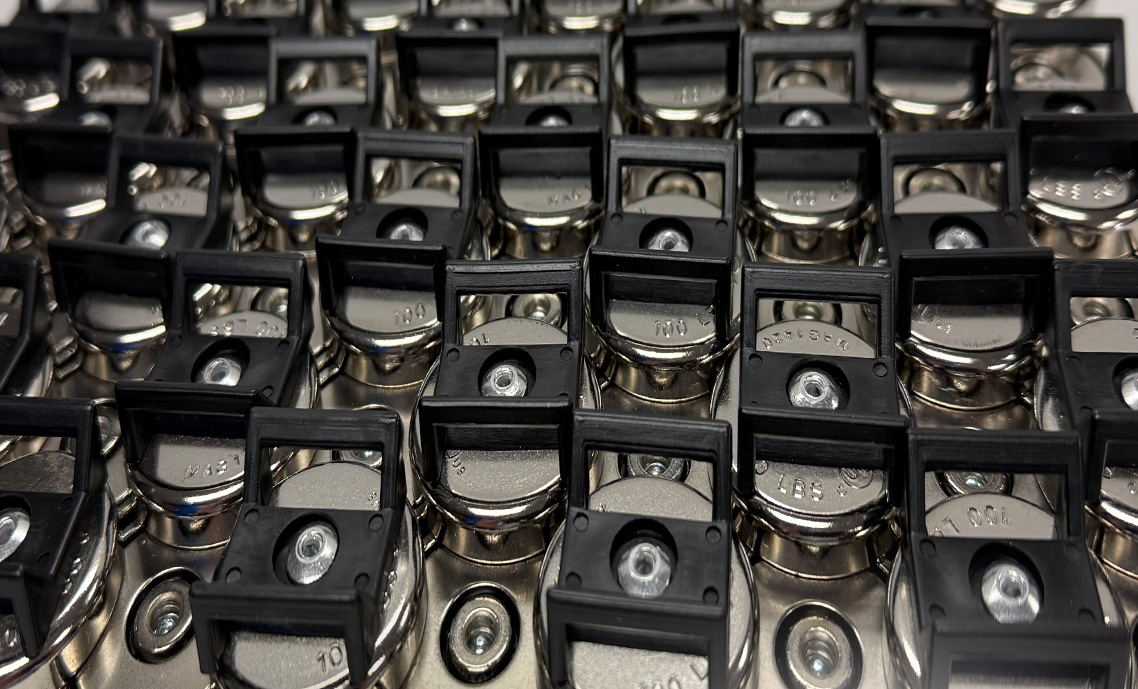
Magnet Grades Demystified
Magnets are engineered in a wide range of materials and grades, each offering distinct advantages in strength, temperature tolerance, and environmental durability. Whether you're sourcing components for motors, sensors, mounts, or precision instruments, selecting the right magnet type is critical for reliable field deployment.
The following reference sections break down the most commonly used magnet families—Neodymium, Ceramic/Ferrite, Samarium Cobalt, and Alnico—along with their grades, performance specs, and practical use cases.
Neodymium (NdFeB) Magnets
Neodymium magnets are the strongest commercially available magnets. They offer high magnetic strength in compact sizes, but are sensitive to corrosion and heat unless specially coated or graded.
| Grade | BHmax (MGOe) | Temp Suffix | Max Temp | Field Use Case |
|---|---|---|---|---|
| N35 | ~35 | N | 80°C | Compact assemblies, magnetic clasps, sensors with minimal heat exposure |
| N35M | ~35 | M | 100°C | Enclosures, mounts, actuators in moderate heat |
| N35H | ~35 | H | 120°C | Motor stators, magnetic couplings, robotics |
| N35SH | ~35 | SH | 150°C | Industrial automation, magnetic brakes, servo systems |
| N35UH | ~35 | UH | 180°C | High-speed motors, downhole tools, thermal-sensitive electronics |
| N35EH | ~35 | EH | 200°C | Aerospace sensors, turbine instruments, extreme heat zones |
| N52 | ~52 | N | 80°C | Magnetic latches, actuators, precision alignment tools |
| N52M | ~52 | M | 100°C | Grippers, locking mechanisms, compact motors |
| N52H | ~52 | H | 120°C | High-performance motors, gears, field tools |
| N52SH | ~52 | SH | 150°C | Industrial robotics, separators, high-load actuators |
Ceramic / Ferrite Magnets
Ferrite (ceramic) magnets are made from iron oxide and strontium carbonate. They are low-cost, corrosion-resistant, and stable at high temperatures, though weaker than rare-earth magnets.
| Grade | BHmax (MGOe) | Alt Name | Max Temp | Field Use Case |
|---|---|---|---|---|
| C1 | ~1.1 | Y10 | 250°C | Signage, whiteboards, educational kits |
| C5 | ~3.5 | Y30 | 250°C | Speaker drivers, tool holders, basic motors |
| C8 | ~4.3 | Y40 | 250°C | DC motors, sensors, industrial mounts |
Samarium Cobalt (SmCo) Magnets
Samarium cobalt magnets are rare-earth magnets known for excellent thermal stability and corrosion resistance. They perform reliably in high-temperature and harsh environments.
| Grade | BHmax (MGOe) | Type | Max Temp | Field Use Case |
|---|---|---|---|---|
| SmCo5 | ~18–22 | 1st Gen | 250°C | Compact motors, encoders, aerospace sensors |
| Sm2Co17 | ~24–30 | 2nd Gen | 350°C | High-speed rotors, actuators, defense electronics |
| SmCo28 | ~28 | — | 350°C | Satellites, high-frequency sensors, precision instruments |
Alnico Magnets
Alnico magnets are made from aluminum, nickel, and cobalt. They offer excellent temperature stability and are commonly used in instruments, sensors, and legacy systems.
| Grade | BHmax (MGOe) | Max Temp | Field Use Case |
|---|---|---|---|
| Alnico 2 | ~2.5 | 540°C | Guitar pickups, analog sensors, legacy instruments |
| Alnico 5 | ~5.5 | 540°C | Measuring devices, compasses, rotating machinery |
| Alnico 8 | ~9.0 | 540°C | Magnetos, chucks, high-temp holding systems |
Quick Comparison by Strength
This summary compares magnet types by their energy product (BHmax) and maximum operating temperature. Use it to quickly assess which material suits your application environment.
| Material | BHmax Range (MGOe) | Max Temp Range |
|---|---|---|
| Neodymium (NdFeB) | 35–52 | 80–200°C |
| Samarium Cobalt (SmCo) | 18–30 | 250–350°C |
| Alnico | 2.5–9 | Up to 540°C |
| Ceramic / Ferrite | 1–4.3 | Up to 250°C |
By understanding how each magnet type performs across strength, temperature, and application demands, you can confidently select the right grade for reliable, field-tested results.
The information provided in this FAQ is for general informational purposes only and is not intended to replace official codes, standards, or project specifications. Winnie Industries products must always be installed and used in accordance with our product instruction sheets or designated training. Products should never be applied beyond their intended purpose or in a manner that exceeds specified load ratings. Proper fastening is critical to system integrity and functionality, requiring secure attachment to structurally sound components capable of supporting imposed loads. All installations must comply with governing codes, regulations, and job site requirements. Always consult your Authority Having Jurisdiction (AHJ) for specific regulatory guidance.