

The House That Knew Too Much
Smart homes and multi‑dwelling units (MDUs) are built around connected low‑voltage systems that automate lighting, climate control, security, entertainment, access control, and a growing ecosystem of IoT devices. These environments rely on structured cabling and PoE‑driven infrastructure to deliver data and power to dozens or even hundreds of smart devices per unit. In MDUs, shared infrastructure such as risers, fiber backbones, and telecom closets supports centralized services, while individual units require zoned cabling, media panels, and upgrade‑ready pathways. Both smart homes and MDUs depend on precise cable management, support hardware, and documentation to ensure long‑term reliability, safety, and flexibility as home automation and connected‑living technologies continue to evolve.
The following questions explore the cabling considerations, installation practices, and management approaches commonly involved in supporting these connected residential environments.
Residential Cabling Fundamentals
1. What defines a smart home or MDU from a cabling perspective?
A smart home or MDU integrates networked low-voltage systems—lighting, climate control, door locks, surveillance, AV, intercom, shading, appliances, and IoT sensors. This convergence requires structured cabling that supports both data and power across dozens to hundreds of endpoints per unit while meeting NEC 2026 requirements for separation, support, and grounding.
2. What cabling types are used in smart homes and MDUs?
Smart residences rely on cabling that supports bandwidth, power delivery, and environmental resilience:
- Category 5e: Common in legacy installs; supports 1 Gb/s and basic PoE.
- Category 6: Standard for modern residential data and PoE applications.
- Category 6A: Preferred for high-bandwidth, PoE+, and PoE++ loads.
- Shielded Twisted Pair (STP): Used in EMI-dense or retrofit environments.
- Plenum-Rated Cable: Required in MDUs and air-handling spaces.
- Hybrid LV Signal + Power Cable: Supports sensors, lighting, shades, and automation.
- Fiber Optic Cable: Used for MDU risers, backbone links, and long-distance runs.
Cable selection must align with voltage class, PoE wattage, bandwidth, and environmental exposure.
3. How do smart homes affect cable selection?
Cable selection must support bandwidth, PoE load, distance, EMI, and environmental conditions:
- High-bandwidth zones (APs, media rooms) often require Category 6A.
- High-wattage PoE devices may require shielded cable and thermal derating.
- Attics and risers require plenum-rated jackets and temperature consideration.
- Retrofit environments may require flexible or hybrid LV bundles.
- Fiber is used when distance, EMI, or future-proofing demands it.
Selection must comply with NEC 2026 limited-energy separation and mechanical protection rules.
4. How should networks be segmented in smart homes and MDUs?
Smart homes and MDUs require clear separation between homeowner networks, building services, and shared infrastructure. In single-family homes, segmentation isolates automation devices, cameras, guest Wi-Fi, and homeowner data. In MDUs, segmentation becomes mandatory: each unit must have isolated VLANs or physical ports, with building systems—access control, cameras, intercom, management networks—kept fully separate. Segmentation prevents cross-tenant access, reduces interference, and protects building-wide systems from consumer devices.
5. How should media panels and structured wiring enclosures be designed?
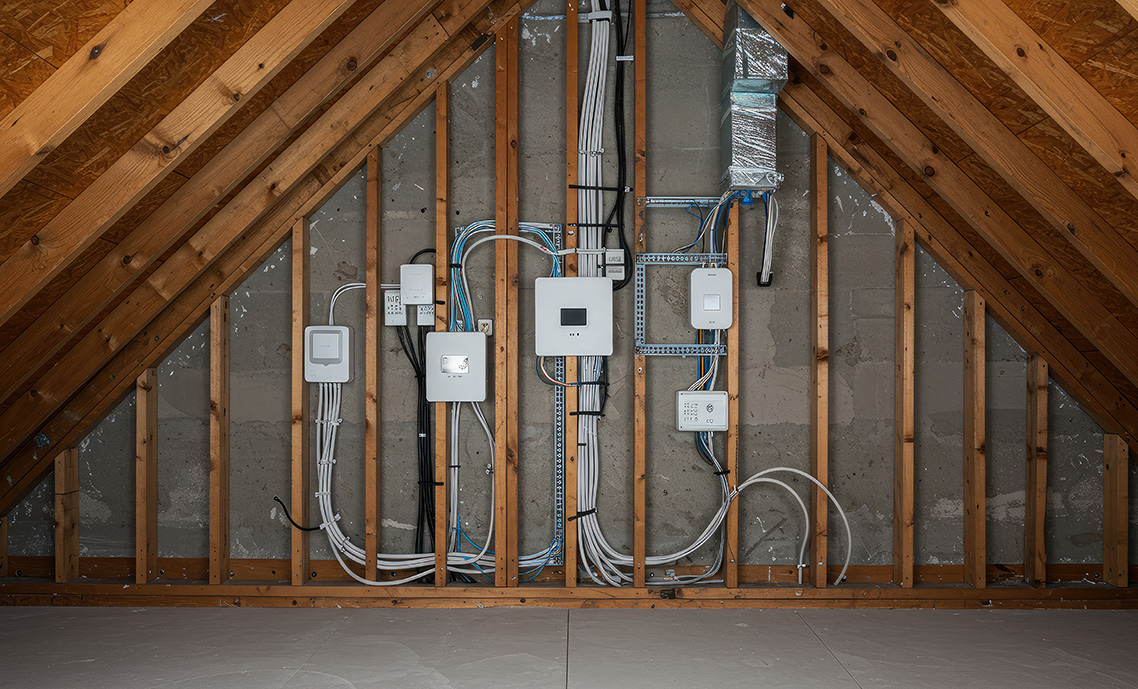
Media panels must support power, grounding, PoE distribution, cable slack management, and future expansion. Panels should include dedicated receptacles, surge protection, ventilation, and space for gateways, switches, and automation hubs. In MDUs, panels must also support unit-level demarcation, labeling, and isolation from shared risers. Enclosures should be sized for at least 50% future growth and allow clean routing of Cat cable, coax, fiber, and low-voltage power.
Pathways, Layout, and Environmental Constraints
6. How does device density affect residential cabling strategy?
Modern homes average 20–30 connected devices; MDUs often exceed 50–100 per unit. This density drives centralized media panels, scalable pathways, distributed AP placement, and modular enclosures sized for future growth. Density shapes how cabling is routed, powered, and maintained across each unit or dwelling.
7. What are the key changes in cable pathway design for homes and MDUs?
Residential pathways must support reliability, serviceability, and future upgrades:
- Shared risers in MDUs require firestopping and tenant isolation.
- Media panels must support power, grounding, and PoE distribution.
- Redundancy is needed for critical systems such as security and HVAC.
- Thermal separation between power and data prevents interference.
- Enclosures should be sized for 50% future expansion.
Pathways must remain accessible for MAC (Moves, Adds, Changes).
8. How do you manage cable supporting smart home hardware?
Cable support must prevent sagging, stress, and overheating:
- Use properly sized J hooks, bridle rings, trays, or magnetic cable managers.
- Match support hardware to bundle weight and bend radius.
- Reduce spacing to 24–36 inches in dense or attic runs.
- Provide strain relief for vertical drops.
- Protect cables from sharp edges, heat sources, and mechanical damage.
Proper support preserves PoE performance, signal integrity, and service life.
9. How is exterior cabling managed in smart homes and MDUs?
Exterior cabling must withstand weather, UV, and moisture:
- Use UV-rated jackets and gel-filled or water-blocking cable.
- Apply burial-rated constructions at 18–24 inches.
- Add drip loops at entry points.
- Transition through weather-sealed boxes or conduit.
- Use listed entrance fittings and grounding per NEC Article 800.
Exterior cabling must meet local code and MDU fire-separation requirements.
10. What’s different between retrofit and new construction cabling?
Retrofit projects require fishing through finished walls, attic routing, and reuse of existing pathways. New construction allows conduit pre-runs, riser planning, and larger media panels. Each scenario requires different bend-radius, access, and enclosure planning.
Power Delivery, PoE, and Cable Selection
11. How does Power over Ethernet (PoE) impact residential cabling?
PoE powers cameras, APs, intercoms, doorbells, lighting, and automation devices:
- Thermal bundling must be managed in attics and risers.
- Shielded cable may be required for high-load PoE++ devices.
- Category 6A is preferred for higher wattage.
- Separation from power circuits must follow NEC 2026.
- Mechanical protection is required in exposed areas.
PoE performance depends on proper cable selection and thermal management.
12. What role does grounding and bonding play in residential cabling?
Grounding and bonding ensure safety, performance, and interference suppression:
- Ground shielded cable to prevent noise.
- Bond metal raceways and media enclosures.
- Coordinate grounding with electrical systems to avoid loops.
- Maintain surge protection at entry points.
- Follow NEC 2026 for limited-energy grounding requirements.
Improper grounding can degrade PoE, cause false alarms, or reduce signal quality.
13. How does smart lighting affect cabling strategy?
Smart lighting systems—PoE lighting, tunable white, RGB, and LV ecosystems—require:
- Hybrid LV cable for signal + power.
- Support for DALI, DMX, or proprietary protocols.
- Thermal separation from power circuits.
- Centralized LV power supplies (Class 2 or Class 3).
- Proper grounding and enclosure sizing.
Lighting loads often drive the shift to Category 6A or shielded cable.
14. How do AV, intercom, and IoT systems influence cabling?
Smart homes and MDUs integrate multiple subsystems that require structured cabling:
- AV distribution: Cat6A, fiber, or HDMI-over-IP extenders.
- Intercom and access control: PoE and shielded cable.
- Doorbells and cameras: Exterior-rated PoE or LV cable.
- Shades and window treatments: LV power + control wiring.
- Appliances: Increasingly Ethernet or Wi-Fi backhaul.
- IoT sensors: LV power, Cat cable, or wired backhaul for hubs.
Subsystems must share pathways without interference or thermal overload.
Labeling, Documentation, and Standards
15. Are there changes in labeling and documentation for residential systems?
Smart homes and MDUs require:
- Circuit ID, device type, protocol, and power class labeling.
- Unit-level labeling in MDUs.
- QR-coded asset tags for traceability.
- Documentation that supports MAC workflows.
- Integration with homeowner apps or property management systems.
Labeling is essential for serviceability and diagnostics.
16. How is shared infrastructure handled in MDUs?
MDUs require centralized backbone planning and tenant isolation:
- Fiber risers and telecom closets support shared services.
- Demarcation points must be clearly labeled per unit.
- Firestopping is required at every floor penetration.
- Patch panels and enclosures must isolate tenant traffic.
- Shielded cable reduces crosstalk in dense risers.
Coordination with property management ensures long-term serviceability.
17. What standards govern smart home and MDU cabling?
Key standards include ANSI/TIA-568, TIA-570-D (residential), IEEE 802.3 (Ethernet/PoE), and NFPA 70 (NEC). Local building and fire codes apply, especially in MDUs with shared risers and fire-rated assemblies.
Wireless Integration and Workforce Requirements
18. What’s the role of wireless in smart homes and MDUs?
Wireless complements—not replaces—structured cabling:
- APs require wired backhaul and PoE power.
- Channel planning is critical in MDUs to avoid interference.
- Mesh or distributed AP placement improves coverage.
- Wired backhaul supports streaming, automation, and IoT hubs.
- Grounding and surge protection improve reliability.
Cabling supports the wireless infrastructure that enables mobility and automation.
19. How does this impact residential installers and specifiers?
Installers must manage bend-radius constraints, thermal bundling limits, limited-energy separation, labeling discipline, attic/riser temperature considerations, and firestopping in MDUs. Specifiers must coordinate across low-voltage, electrical, HVAC, and automation disciplines to ensure long-term scalability and upgrade paths.
Future Direction
20. What’s next for smart home and MDU cabling?
Expect deeper integration with edge computing, AI-driven automation, and real-time diagnostics. Cabling will support intelligent LV lighting, distributed compute nodes, high-density IoT, remote management for MDUs, increased PoE loads, and hybrid LV ecosystems—forming the backbone of adaptive, resilient residential infrastructure.
Smart homes and MDUs rely on structured cabling to support automation, connectivity, and control—linking systems like lighting, climate, security, and entertainment into a unified, reliable infrastructure.
The information provided in this FAQ is for general informational purposes only and is not intended to replace official codes, standards, or project specifications. Winnie Industries products must always be installed and used in accordance with our product instruction sheets or designated training. Products should never be applied beyond their intended purpose or in a manner that exceeds specified load ratings. Proper fastening is critical to system integrity and functionality, requiring secure attachment to structurally sound components capable of supporting imposed loads. All installations must comply with governing codes, regulations, and job site requirements. Always consult your Authority Having Jurisdiction (AHJ) for specific regulatory guidance.