

Where Uptime Lives
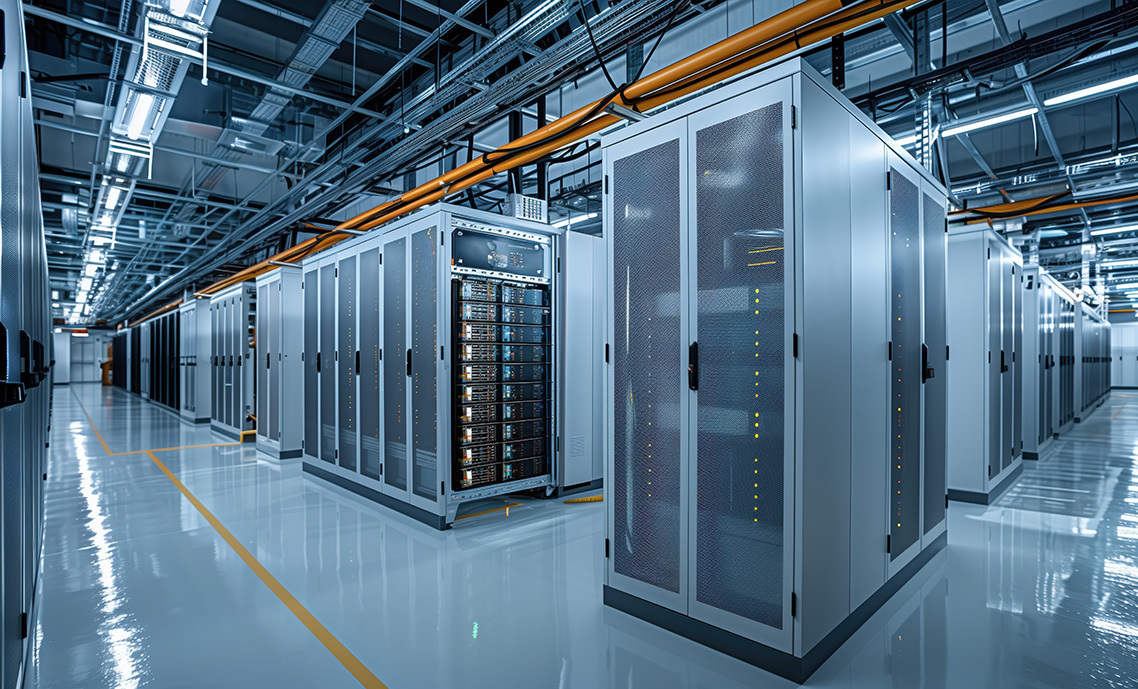
A data center is a purpose‑built facility that houses compute, storage, networking, power, and cooling infrastructure to support continuous digital operations. Engineered for uptime, security, and scalability, it integrates building‑level systems—such as the electrical room, mechanical yard, and controlled white space—with redundant power distribution, precision cooling, and structured cabling. As AI and high‑density workloads grow, data centers increasingly rely on advanced cooling methods, resilient network fabrics, and fault‑tolerant power architectures to maintain performance. Whether deployed on‑premises, at the edge, or at hyperscale, every data center is designed to balance efficiency, reliability, and physical security, guided by standards that shape airflow, power continuity, environmental controls, and overall facility layout.
To anchor the fundamentals, the following glossary highlights essential data center terms and their relevance in modern facilities.
Data Center Architecture & Facility Layout
Building Envelope
Definition: The exterior shell of the data center that controls heat, air, and moisture transfer. It directly affects energy efficiency and environmental stability.
Standards: ASHRAE, local building codes.
Field Relevance: Impacts cooling performance, humidity control, and overall energy usage.
Electrical Room
Definition: A dedicated space housing switchgear, UPS systems, batteries, and other electrical distribution equipment.
Standards: NEC, NFPA 70E.
Field Relevance: Central to power distribution and maintenance access.
Egress Path
Definition: The designated route for safe exit during an emergency, including aisles, corridors, and exit doors.
Standards: NFPA 101 Life Safety Code.
Field Relevance: Ensures personnel safety and compliance with fire codes.
Fire Rating
Definition: The fire‑resistance classification of walls, doors, and barriers used to contain fire and smoke.
Standards: NFPA, IBC.
Field Relevance: Determines separation of critical rooms and protects infrastructure during fire events.
Floor Loading
Definition: The maximum weight a floor can support, including racks, UPS systems, and batteries.
Standards: Structural engineering codes.
Field Relevance: Critical for placing heavy equipment and ensuring structural integrity.
Loading Dock
Definition: The receiving area for equipment deliveries, staging, and outbound shipments.
Standards: OSHA, facility logistics guidelines.
Field Relevance: Supports safe and efficient movement of racks, generators, and large components.
Make‑Up Water
Definition: Water supplied to cooling towers or chilled‑water systems to replace evaporation and losses.
Standards: ASHRAE, local water regulations.
Field Relevance: Essential for maintaining cooling system performance and reliability.
Mechanical Yard
Definition: The outdoor area housing chillers, cooling towers, generators, and other mechanical systems.
Standards: Local building codes, ASHRAE.
Field Relevance: Provides space for major cooling and power equipment with required clearances.
Seismic Rating
Definition: The building’s classification for earthquake resistance, dictating anchoring and bracing requirements.
Standards: IBC, ASCE 7.
Field Relevance: Ensures equipment stability and safety in seismic regions.
Security Operations Center (SOC)
Definition: A dedicated room where physical security systems are monitored and managed.
Standards: ISO 27001 (physical security controls).
Field Relevance: Centralizes surveillance, access control, and incident response.
Utility Entrance
Definition: The point where electrical and telecommunications services enter the building.
Standards: NEC, utility provider specifications.
Field Relevance: Determines redundancy, routing, and protection of incoming services.
Rack, Room & Facility Infrastructure
Blanking Panel
Definition: A filler panel installed in unused rack spaces to prevent air recirculation and maintain proper airflow direction.
Standards: ASHRAE thermal guidelines.
Field Relevance: Improves cooling efficiency and reduces hot‑spot formation.
Blanking Panel Strategy
Definition: The practice of consistently using blanking panels to seal open rack spaces and maintain airflow integrity.
Standards: ASHRAE best practices.
Field Relevance: Supports predictable cooling performance and reduces energy waste.
Colocation (Colo)
Definition: A data center model where customers lease space, power, and cooling for their own IT equipment.
Standards: Varies by provider; governed by SLAs.
Field Relevance: Enables scalable infrastructure without owning a full facility.
False Floor
Definition: A raised flooring system used to route cabling or conditioned air beneath the IT environment.
Standards: ANSI/BICSI 002.
Field Relevance: Common in legacy designs; supports airflow and cable management.
Floor Grommet
Definition: A sealed opening in raised floors that allows cables to pass through while minimizing air leakage.
Standards: ASHRAE airflow guidelines.
Field Relevance: Helps maintain cooling efficiency and containment integrity.
Gray Space
Definition: The non‑IT support areas of a data center, including electrical rooms, mechanical spaces, and back‑of‑house infrastructure.
Standards: Facility design guidelines.
Field Relevance: Houses critical systems that support the white space.
Mantrap
Definition: A controlled entry vestibule requiring authentication to enter and exit, preventing unauthorized access.
Standards: ISO 27001 physical security controls.
Field Relevance: Provides layered security and prevents tailgating.
Perimeter Security
Definition: The combination of fencing, surveillance, access control, and monitoring that protects the exterior boundary of a data center.
Standards: ISO 27001, local security codes.
Field Relevance: Forms the first line of defense against unauthorized access.
Raised Floor
Definition: A modular flooring system elevated above the building slab to allow airflow or cable routing beneath.
Standards: ANSI/BICSI 002.
Field Relevance: Common in traditional data centers; supports cooling and cable management.
White Space
Definition: The primary IT area where racks, servers, and networking equipment are installed.
Standards: ASHRAE thermal guidelines.
Field Relevance: Represents the revenue‑generating or production computing environment.
Power Architecture & Electrical Systems
2N Redundancy
Definition: A fully duplicated power and cooling architecture with no shared components or single points of failure.
Standards: Uptime Institute Tier IV.
Field Relevance: Ensures maximum uptime and supports fault‑tolerant operations.
Ampere (A)
Definition: The basic unit of electrical current used to measure load on circuits and equipment.
Standards: IEEE, NEC.
Field Relevance: Essential for sizing breakers, PDUs, and branch circuits.
Arc Flash Mitigation
Definition: Strategies and equipment used to reduce the energy released during an arc flash event.
Standards: NFPA 70E.
Field Relevance: Protects personnel and equipment during electrical faults.
Automatic Transfer Switch (ATS)
Definition: A device that automatically transfers electrical load between primary and backup power sources.
Standards: UL 1008.
Field Relevance: Ensures continuity of power during utility outages.
Battery Bank
Definition: A collection of batteries used to provide short‑term backup power for UPS systems.
Standards: IEEE 1184.
Field Relevance: Supports ride‑through until generators start.
Branch Circuit
Definition: The final segment of electrical distribution delivering power from a panelboard to equipment.
Standards: NEC 210.
Field Relevance: Determines load capacity and breaker sizing for IT racks.
Busway
Definition: An overhead or underfloor power distribution system using enclosed bus bars instead of traditional cabling.
Standards: UL 857.
Field Relevance: Provides flexible, scalable power delivery for high‑density racks.
Energy Storage System (ESS)
Definition: A system that stores electrical energy, typically using lithium‑ion or other advanced chemistries, to support power continuity.
Standards: NEC Article 706.
Field Relevance: Enhances resilience and can supplement or replace traditional battery banks.
Flywheel
Definition: A mechanical energy storage device that provides short‑duration backup power through rotational inertia.
Standards: IEEE energy storage guidelines.
Field Relevance: Offers fast response and long service life for UPS systems.
Generator Paralleling
Definition: The process of synchronizing multiple generators to operate together as a unified power source.
Standards: NFPA 110.
Field Relevance: Increases capacity, redundancy, and operational flexibility.
Medium Voltage Distribution
Definition: Electrical distribution operating between 1 kV and 35 kV, typically used for utility feeds and large equipment.
Standards: IEEE, NEC.
Field Relevance: Reduces losses and supports large‑scale power delivery.
Selective Coordination
Definition: The design practice of ensuring only the nearest upstream protective device trips during a fault.
Standards: NEC 700 and 701.
Field Relevance: Prevents cascading outages and maintains uptime.
Utility Redundancy
Definition: The use of multiple independent utility feeds to ensure continuous power availability.
Standards: Utility provider specifications, NEC.
Field Relevance: Reduces risk of outages caused by external grid failures.
Thermal Management & Cooling Systems
Airside Economizer
Definition: A cooling method that uses filtered outside air to reduce or eliminate mechanical cooling when conditions allow.
Standards: ASHRAE TC 9.9.
Field Relevance: Lowers energy consumption and improves efficiency in suitable climates.
Chilled Water System
Definition: A cooling system that circulates chilled water through coils or heat exchangers to remove heat from the data hall.
Standards: ASHRAE, mechanical design codes.
Field Relevance: Common in large data centers for high efficiency and scalability.
Chiller Plant
Definition: A centralized system that produces chilled water for cooling the facility, typically using compressors and heat exchangers.
Standards: ASHRAE, mechanical engineering standards.
Field Relevance: Forms the backbone of water‑cooled data center designs.
Cold Aisle Containment (CAC)
Definition: A system that encloses cold aisles to separate supply air from hot exhaust air, improving cooling efficiency.
Standards: ASHRAE thermal guidelines.
Field Relevance: Reduces mixing of air streams and enhances cooling performance.
Containment
Definition: The practice of physically separating hot and cold air paths to improve cooling efficiency and airflow control.
Standards: ASHRAE best practices.
Field Relevance: Supports higher rack densities and reduces energy use.
Cooling Tower
Definition: An outdoor heat‑rejection system that removes heat from water through evaporation or air exchange.
Standards: ASHRAE, mechanical codes.
Field Relevance: Essential for water‑cooled and economizer‑enabled data centers.
Direct Expansion (DX)
Definition: A cooling method where refrigerant directly absorbs heat from the air without a chilled‑water loop.
Standards: HVAC manufacturer specifications.
Field Relevance: Common in smaller or edge data centers.
Direct‑to‑Chip Liquid Cooling
Definition: A cooling method that circulates liquid directly to cold plates mounted on CPUs or GPUs to remove heat at the source.
Standards: ASHRAE liquid cooling guidelines.
Field Relevance: Supports high‑density compute such as AI and HPC workloads.
Free Cooling
Definition: A cooling approach that uses naturally cool air or water to reduce mechanical cooling demand.
Standards: ASHRAE TC 9.9.
Field Relevance: Improves energy efficiency and reduces operational costs.
Hot Aisle Containment (HAC)
Definition: A system that encloses hot aisles to isolate exhaust air and direct it back to cooling units.
Standards: ASHRAE thermal guidelines.
Field Relevance: Enhances cooling efficiency and supports higher rack densities.
Immersion Cooling
Definition: A cooling method where IT equipment is submerged in a thermally conductive dielectric fluid to dissipate heat.
Standards: ASHRAE immersion cooling guidance.
Field Relevance: Enables extreme density and reduces reliance on air‑based cooling.
Rear‑Door Heat Exchanger (RDHx)
Definition: A rack‑mounted cooling unit that removes heat from exhaust air using a liquid‑cooled coil at the rear of the rack.
Standards: ASHRAE liquid cooling guidelines.
Field Relevance: Supports high‑density racks without major room‑level cooling changes.
Cabling, Connectivity & Network Infrastructure
Access Point (AP)
Definition: A wireless networking device that enables Wi‑Fi connectivity within the facility or office areas adjacent to the data center.
Standards: IEEE 802.11.
Field Relevance: Supports wireless access for staff devices and facility operations.
Active Optical Cable (AOC)
Definition: A pre‑terminated optical cable assembly with integrated transceivers for high‑speed data transmission.
Standards: IEEE Ethernet standards.
Field Relevance: Simplifies high‑bandwidth connections between switches and servers.
ANSI/TIA‑606 Labeling Standard
Definition: A structured cabling standard defining labeling and documentation requirements for telecommunications infrastructure.
Standards: ANSI/TIA‑606‑D.
Field Relevance: Ensures consistent identification of cables, racks, and pathways.
Basket Tray
Definition: A wire‑mesh cable pathway used to route and support data cabling overhead or underfloor.
Standards: BICSI installation guidelines.
Field Relevance: Provides flexible cable routing and easy access for changes.
Cable Tester
Definition: A device used to verify continuity, performance, and certification of copper or fiber cabling.
Standards: TIA/EIA cabling standards.
Field Relevance: Ensures cabling meets performance requirements before deployment.
Cable Tray
Definition: A rigid pathway system used to support and organize large volumes of cabling.
Standards: NEMA VE 1.
Field Relevance: Provides structured cable management and reduces installation complexity.
Carrier Neutral Facility
Definition: A data center where multiple telecommunications carriers provide connectivity options.
Standards: SLA‑based, not governed by a single standard.
Field Relevance: Enables diverse network paths and competitive pricing.
Cross‑Connect
Definition: A physical cabling link between two separate networks, carriers, or customer environments within a data center.
Standards: TIA‑568.
Field Relevance: Provides secure, low‑latency interconnection between parties.
Fiber Distribution Panel
Definition: A rack‑mounted enclosure used to terminate, organize, and manage fiber optic connections.
Standards: TIA‑568, TIA‑942.
Field Relevance: Supports structured fiber management and reduces strain on cables.
Fiber Optic Cable
Definition: A high‑bandwidth transmission medium using light signals to carry data over long distances.
Standards: TIA‑568, ITU‑T G.652/G.657.
Field Relevance: Forms the backbone of modern data center networking.
High‑Speed Optics (QSFP / OSFP)
Definition: Pluggable optical modules used for high‑bandwidth connections such as 100G, 200G, and 400G links.
Standards: IEEE 802.3 Ethernet standards.
Field Relevance: Enables scalable, high‑capacity network fabrics.
Intermediate Distribution Frame (IDF)
Definition: A secondary telecommunications room that aggregates cabling and network equipment for a specific area.
Standards: TIA‑569.
Field Relevance: Supports structured cabling and reduces long cable runs.
IP Address (IPv4 / IPv6)
Definition: A numerical identifier assigned to devices on a network to enable routing and communication.
Standards: IETF RFCs.
Field Relevance: Fundamental to network configuration and traffic management.
MPO/MTP
Definition: A multi‑fiber connector system used for high‑density optical connections in modern data centers.
Standards: IEC 61754‑7.
Field Relevance: Supports rapid deployment of high‑bandwidth fiber links.
Multimode Fiber (OM3/OM4/OM5)
Definition: Fiber types optimized for short‑distance, high‑bandwidth transmission using multiple light modes.
Standards: ISO/IEC 11801.
Field Relevance: Common for intra‑data‑hall connectivity.
Pathway Separation
Definition: The practice of routing power and data cabling in separate pathways to reduce interference and improve safety.
Standards: NEC, TIA‑569.
Field Relevance: Prevents EMI issues and supports clean cable management.
Single‑Mode Fiber (OS2)
Definition: A fiber type designed for long‑distance, high‑bandwidth transmission using a single light mode.
Standards: ITU‑T G.652/G.657.
Field Relevance: Used for backbone, carrier, and long‑run data center links.
Compute, Storage & IT Systems
AI Pod
Definition: A modular cluster of GPU‑accelerated servers designed to run large‑scale AI training or inference workloads.
Standards: Vendor‑specific architecture guidelines.
Field Relevance: Supports high‑density compute with specialized networking and cooling requirements.
AI Server Node
Definition: A single server equipped with GPUs or accelerators optimized for AI and machine learning tasks.
Standards: Manufacturer specifications.
Field Relevance: Forms the building block of AI clusters and high‑performance compute environments.
Bare Metal Server
Definition: A physical server dedicated to a single tenant or workload without a virtualization layer.
Standards: Data center hosting and SLA requirements.
Field Relevance: Provides maximum performance and isolation for demanding workloads.
Block Storage
Definition: A storage architecture that divides data into fixed‑size blocks accessed through a storage area network (SAN).
Standards: SCSI, NVMe‑oF, Fibre Channel standards.
Field Relevance: Used for databases, virtual machines, and high‑performance applications.
Compute Cluster
Definition: A group of interconnected servers that operate as a unified compute resource.
Standards: HPC and distributed computing frameworks.
Field Relevance: Enables scalable processing for AI, HPC, and cloud workloads.
GPU Server
Definition: A server equipped with graphics processing units designed for parallel computation.
Standards: Vendor‑specific GPU architecture guidelines.
Field Relevance: Essential for AI training, rendering, and scientific computing.
Hyperconverged Infrastructure (HCI)
Definition: An architecture that integrates compute, storage, and networking into a single software‑defined platform.
Standards: Vendor‑specific HCI frameworks.
Field Relevance: Simplifies deployment and scaling of virtualized environments.
Object Storage
Definition: A storage architecture that manages data as objects rather than blocks or files.
Standards: S3 API, cloud storage protocols.
Field Relevance: Ideal for unstructured data, backups, and large‑scale storage pools.
Rack Server
Definition: A server designed to be mounted in a standardized 19‑inch equipment rack.
Standards: EIA‑310 rack standards.
Field Relevance: The most common form factor for data center compute.
Storage Area Network (SAN)
Definition: A dedicated high‑speed network that provides access to consolidated block‑level storage.
Standards: Fibre Channel, iSCSI, NVMe‑oF.
Field Relevance: Supports mission‑critical workloads requiring high throughput and low latency.
Virtual Machine (VM)
Definition: A software‑based emulation of a physical computer running on a hypervisor.
Standards: Virtualization platform specifications.
Field Relevance: Enables workload consolidation and flexible resource allocation.
Virtualization
Definition: The abstraction of compute, storage, or networking resources from physical hardware.
Standards: Hypervisor and cloud platform standards.
Field Relevance: Forms the foundation of cloud computing and modern data center operations.
Together, these terms form the operational language of the data center—anchoring every decision, standard, and deployment in precision, continuity, and field relevance.
The information provided in this FAQ is for general informational purposes only and is not intended to replace official codes, standards, or project specifications. Winnie Industries products must always be installed and used in accordance with our product instruction sheets or designated training. Products should never be applied beyond their intended purpose or in a manner that exceeds specified load ratings. Proper fastening is critical to system integrity and functionality, requiring secure attachment to structurally sound components capable of supporting imposed loads. All installations must comply with governing codes, regulations, and job site requirements. Always consult your Authority Having Jurisdiction (AHJ) for specific regulatory guidance.