

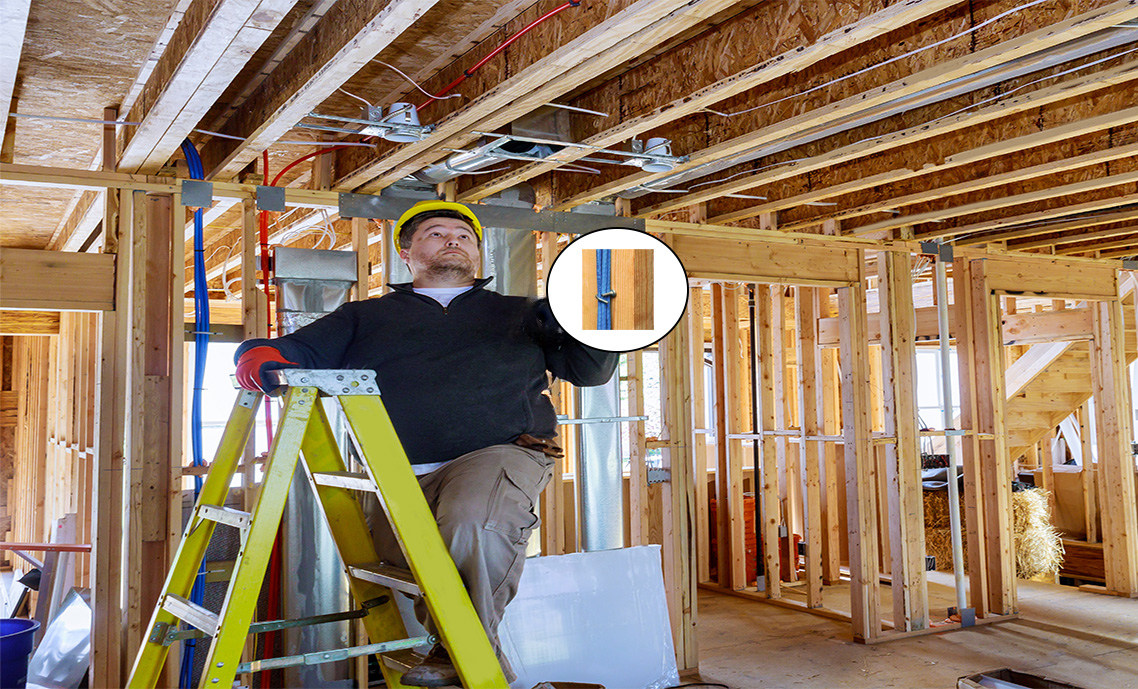
Hammer Time
Drive rings are compact, hammer‑in cable supports used to route limited energy wiring across exposed surfaces in residential, commercial, and utility environments. Made from galvanized steel and designed for direct‑to‑structure installation, they provide a cost‑effective way to secure telephone, category, coaxial, and control cables in applications where conduit or concealed routing is impractical.
This FAQ outlines key specifications, code considerations, and deployment best practices to ensure compliant, field-ready installations,
Fundamentals
1. What is a drive ring, and how is it used?
A drive ring is a one-piece, hammer-in cable support made of galvanized steel. It features a U-shaped loop with one closed end and one open end for easy cable insertion. The steel pin is driven directly into wood, drywall, or masonry (with anchors) to support limited energy (LE) cable in exposed routing environments.
Cable Compatibility
2. What types of cable are supported?
Drive rings are designed for limited energy (LE) applications, most commonly:
- Telephone cable (station wire, cross‑connect)
- Category cable (Cat5e, Cat6, Cat6A)
- Coaxial cable (RG6 for video or broadband)
- Security system cable (intrusion, sensors)
- Fire alarm cable (FPL, FPLR, FPLP where permitted)
- Access control cable (readers, strikes, REX)
- Speaker and audio cable
- Intercom and paging cable
They are not suitable for high‑voltage circuits. Always verify cable type, jacket rating, and routing environment before deployment.
Sizes and Materials
3. What sizes are available?
Common trade sizes include ½″, ¾″, 1″, and 1¼″. Size selection depends on cable bundle diameter, bend radius requirements, and mounting surface constraints.
4. What materials and finishes are used?
Drive rings are typically constructed from corrosion-resistant galvanized steel.
Comparisons
5. How do drive rings compare to J hooks or loop hangers?
Drive rings are compact and cost-efficient, best for direct-to-structure hammer-in applications. J hooks offer broader support and separation for mixed cable types. Loop hangers provide flexible suspension and are often used in seismic or vibration-prone environments.
Code Compliance
6. Are drive rings code-compliant?
Yes—when installed in exposed environments and spaced per:
- NEC Article 805 (Communications Circuits — replaces legacy 800)
- NEC Article 725 (Class 1–4 Limited Energy Circuits)
- NEC Article 840 (Premises‑Powered Broadband)
- TIA‑569 (Pathways and Spaces)
Note: NEC Article 800 is deprecated under NEC 2026.
Drive rings must not be used in concealed or plenum spaces unless explicitly listed for such use. Always verify with local code officials.
Installation
7. What spacing is recommended?
Typical spacing guidelines include:
- Every 4 to 5 feet for horizontal runs
- Within 12 inches of bends, terminations, or entry points
Improper spacing can lead to cable sag, stress, or noncompliance. Always follow installation best practices and local codes.
8. Can drive rings be used on masonry or concrete?
Yes—with the use of masonry expansion anchors or compatible fasteners. This allows secure installation on:
- Concrete walls
- Utility poles
- Brick or block surfaces
Ensure the fastener is rated for the substrate and load conditions.
Risks
9. What are the risks of improper installation?
Common risks include:
- Overdriving — may deform the ring or damage the mounting surface
- Undersizing — can pinch or stress cables, leading to signal degradation
- Improper spacing — may result in sagging or code violations
Use proper tools, verify alignment, and follow spacing standards to ensure safe and compliant installations.
Applications
10. Where are drive rings most commonly deployed?
Drive rings are ideal for environments where exposed cable routing is permitted and cost efficiency is prioritized. Common deployment zones include:
- Residential retrofits — especially in older homes where wall fishing is impractical
- Utility rooms and service closets — for visible telecom, intercom, or control cable runs
- Attics and crawlspaces — for routing across rafters or trusses in unconditioned spaces
- Basements and unfinished ceilings — for coaxial or speaker wire along exposed framing
- Small commercial builds — in backrooms, small offices, or light industrial spaces
- Temporary or transitional installations — in staging areas or demo zones requiring rapid deployment and removal
Drive rings are not recommended for concealed, plenum, or high-density environments unless explicitly listed for such use.
When fixed-position support, exposed routing, and low-voltage discipline converge, drive rings deliver a compact solution that holds fast—no swing, no sag, no surprises.
The information provided in this FAQ is for general informational purposes only and is not intended to replace official codes, standards, or project specifications. Winnie Industries products must always be installed and used in accordance with our product instruction sheets or designated training. Products should never be applied beyond their intended purpose or in a manner that exceeds specified load ratings. Proper fastening is critical to system integrity and functionality, requiring secure attachment to structurally sound components capable of supporting imposed loads. All installations must comply with governing codes, regulations, and job site requirements. Always consult your Authority Having Jurisdiction (AHJ) for specific regulatory guidance.