

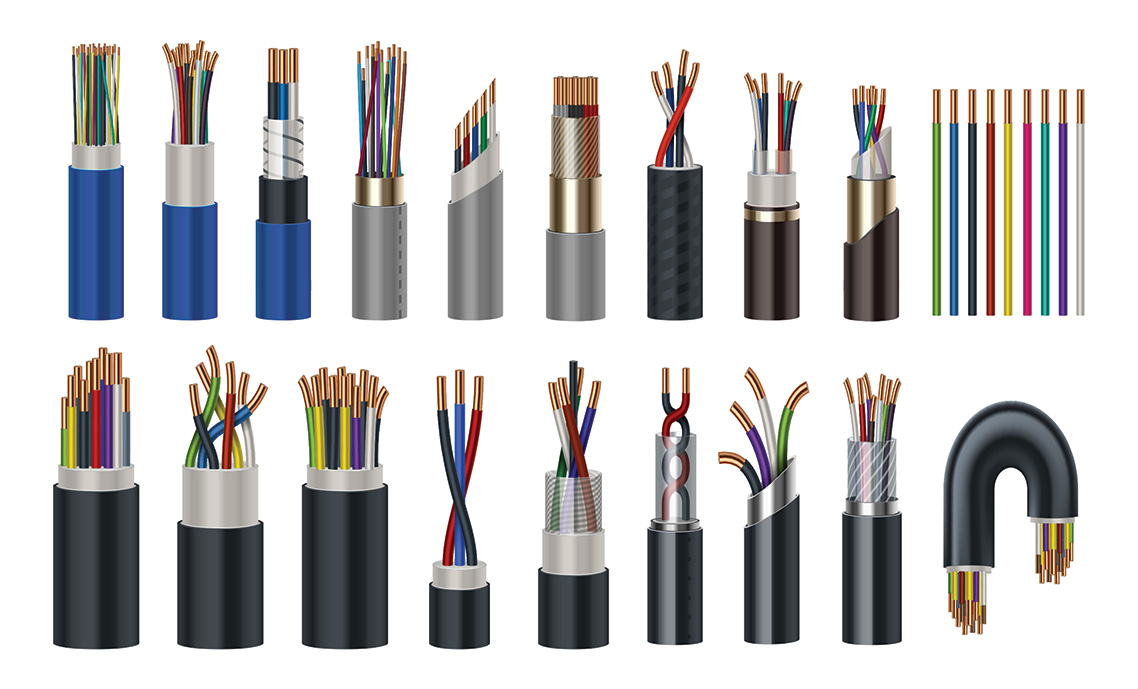
Wired for Purpose: Every Cable, Every Function
Wire and cable types show up everywhere in the field, and knowing the basics helps you choose the right product, avoid installation issues, and keep systems running reliably. This glossary highlights the most commonly used cable types across power, low‑voltage, data, and control work—giving you a quick, practical reference for the options you’ll encounter most on the job.
With this foundation, the glossary below outlines the key wire and cable types used across power, data, control, and low‑voltage work—highlighting their basic characteristics and common applications to support clearer selection and safer installations.
Power & Branch Circuit Cables
AC Cable: Armored cable for branch circuits in residential and commercial buildings.
BX (Legacy Term): A field nickname for early armored cable, still informally used to refer to AC cable though not an official NEC designation.
MC Cable: Metal‑clad cable for commercial and industrial wiring.
NM‑B (Romex®): Non‑metallic sheathed cable for residential branch circuits, subject to derating when bundled or installed in insulation.
Portable Cord (SJ, SJO, SO, SOW): Flexible cable for tools, equipment, and extension cords.
SEU Cable: Service entrance cable for meter‑to‑panel runs.
SER Cable: Service entrance cable for panel feeds.
Submersible Pump Cable: Cable for underwater pump motors in wells and irrigation systems.
TC‑ER Cable: Tray cable rated for exposed runs without conduit in approved installations.
THHN: Building wire for conduit installations.
THWN: Moisture‑resistant wire for wet or damp conduit runs.
Tray Cable: Multi‑conductor cable for industrial power and control in cable trays.
UF‑B: Underground feeder cable for direct burial applications.
XHHW: Heat‑ and moisture‑resistant wire for indoor/outdoor use.
Medium-Voltage & Feeder Cable
AAC / AAAC / ACSR (Overhead Service Cable): Aerial cable for utility power delivery.
MV Cable: Medium‑voltage cable for power distribution.
URD Cable: Direct burial cable for underground residential distribution.
VFD Cables
1kV VFD Cable: Cable for mid‑range VFD systems.
2kV VFD Cable: Cable for long runs and high‑power motors.
600V VFD Cable: Cable for standard motor drive applications.
Armored VFD Cable: Cable for harsh industrial environments requiring physical protection.
Control & Instrumentation Cables
Combination / Hybrid Cable: Bundled power and signal conductors for integrated systems.
Flexible Control Cable: Cable for moving machinery, robotics, and dynamic equipment.
Instrumentation Cable: Cable for low‑voltage signals in process control and monitoring.
Multi‑Conductor Cable: Cable for relays, contactors, and general control wiring.
Multi‑Pair Cable: Cable for analog/digital signal transmission with reduced crosstalk.
Paired Cable: Twisted pair cable for instrumentation and control systems.
Ribbon Cable: Flat cable for internal electronics and control panels.
Communication & Data Cables
Coaxial Cable: Cable for RF signals, CCTV, and broadband.
Fiber Optic Cable: Cable for high‑speed, long‑distance data transmission.
FTP Cable: Foil‑shielded twisted pair for structured cabling.
High‑Pair Count Cable: 25‑, 50‑, and 100‑pair cable for telecom risers and punchdowns.
Ladder Line / Twin‑Lead: RF antenna feedline for amateur radio and broadcast.
Radiating Coax (Leaky Cable): Cable for RF coverage in tunnels and confined spaces.
RS‑232 Cable: Cable for legacy serial data transmission.
RS‑485 Cable: Cable for industrial serial communication and automation.
S/FTP Cable: Individually shielded pairs with overall shield for high‑performance networks.
STP Cable: Shielded twisted pair for EMI‑sensitive environments.
Twinax Cable: Balanced coaxial cable for high‑speed data and legacy networking.
Triax Cable: Broadcast‑grade coaxial cable with added shielding.
UTP Cable (Cat5e, Cat6, Cat6A): Cable for Ethernet, PoE, and LAN systems.
Access Control & Security Cables
18/2 Security Cable: Cable for power to door strikes, sensors, and keypads.
22/2 Security Cable: Cable for contact closures and low‑current devices.
22/4 Security Cable: Cable for multi‑zone sensors and control panels.
Banana Peel Cable: Easy‑separation cable for multi‑function security installs.
Coaxial Security Cable: Cable for analog video transmission (CCTV).
Composite Access Control Cable: Bundled conductors for power, data, and signal.
Twisted Pair Security Cable: Cable for data and signal in access systems.
Specialty Low-Voltage Signal Cables
Direct Burial Cable: Cable for outdoor low‑voltage systems such as irrigation and lighting.
Fire Alarm Cable: Cable for pull stations, strobes, and fire control panels.
Flexible Cable (Multistrand): Cable for dynamic installations requiring movement or vibration resistance.
Irrigation Cable: Cable for connecting sprinkler controllers to valves and sensors.
Intercom Cable: Cable for voice communication between stations.
Landscaping Cable: Cable for outdoor lighting, control zones, and automation systems.
Nurse Call Cable: Cable for patient call systems and emergency annunciators.
Paging Cable: Cable for public address and zone paging systems.
Speaker Cable: Cable for transmitting amplified audio signals to loudspeakers.
Thermostat Wire: Cable for HVAC controls, zone valves, and relays.
Winnie Industries is committed to providing exceptional cable fastening hardware to support the needs of various industries. Look to us to engineer and manufacture innovative solutions that uphold innovation, strength, and dependability.
The information provided in this FAQ is for general informational purposes only and is not intended to replace official codes, standards, or project specifications. Winnie Industries products must always be installed and used in accordance with our product instruction sheets or designated training. Products should never be applied beyond their intended purpose or in a manner that exceeds specified load ratings. Proper fastening is critical to system integrity and functionality, requiring secure attachment to structurally sound components capable of supporting imposed loads. All installations must comply with governing codes, regulations, and job site requirements. Always consult your Authority Having Jurisdiction (AHJ) for specific regulatory guidance.