

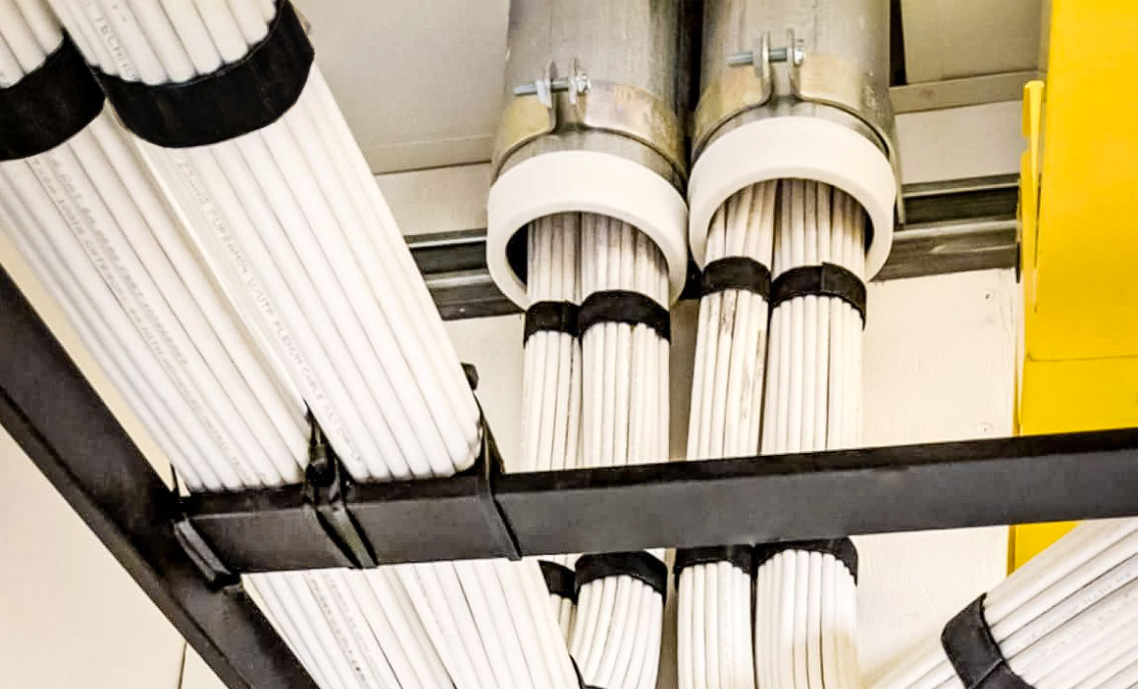
When Cable Crosses Walls
Routing cable through a wall isn’t just a pass‑through—it’s a mechanical protection requirement, an inspection checkpoint, and a firestop boundary. Loose cable pushed through drywall or block risks abrasion, signal issues, and immediate inspection failure. EMT drop conduit creates a clean, durable pathway at wall penetrations and ceiling drops, maintaining separation from other systems, supporting firestop integration, and standardizing room‑to‑room transitions. While often used for low‑voltage or limited energy cable, EMT sleeves apply across data, fiber, coax, and control wiring—making them the accepted method for protecting cable where it crosses a wall.
The following FAQ outlines the requirements, components, and field logic behind using EMT sleeves where cable crosses a wall.
Foundational Understanding
1. What is conduit, and why does it matter?
Conduit is a protective tubing—typically metal or plastic—used to route and shield electrical wiring. EMT (Electrical Metallic Tubing) is the standard for limited-energy cable protection in commercial and industrial settings. It is a semi-rigid metallic raceway, corrosion-resistant, and typically supplied in 10-foot sticks. EMT is used where mechanical protection or routing discipline is required, not for all limited-energy cable runs.
Full-length conduit is difficult to transport and cut on-site. Precut EMT sleeves offer a ready-to-install solution for ceiling drops, wall transitions, and room-to-room cable pathways—reducing labor while preserving finish integrity and installation consistency. They also standardize sleeve length, which improves firestop consistency.
2. Why is conduit used for room-to-room cable transitions?
Loose cable runs through drywall or block often fail inspection and compromise fire integrity. EMT sleeves reinforce clean transitions between rooms, allowing for proper mounting, separation from other systems, and firestop integration. This supports NEC 300.21 and separation requirements in Articles 725, 800, and 805. Whether terminating at a wall plate or enclosure, the conduit path remains durable and ready for final walkthrough.
Code & Compliance (NEC 2026)
1. What NEC 2026 updates apply to EMT sleeves and limited energy pathways?
The 2026 NEC cycle introduced several changes affecting protection, routing, and installation practices for conduit and limited-energy cabling. These updates reinforce damage prevention, fire integrity, and proper separation from other systems. These updates apply to all wiring methods, not specifically EMT sleeves.
- 300.4 – Protection Against Physical Damage: Damaged wiring methods—including conduit exposed to conditions that compromise structural integrity, fire, corrosion, or mechanical impact—must now be replaced, not repaired.
- 300.4(C) – Damaged Wiring Methods and Conductors: Clarifies that compromised wiring methods must be evaluated and replaced per NEMA GD‑1 and GD‑2 guidance.
- 110.3(B) – Manufacturer Instructions: Strengthens enforcement of following manufacturer instructions for clamps, bushings, and firestop components.
- Article Restructuring: Continues the reorganization of communications, Class 2/3, and raceway sections, affecting cross-references used in limited-energy installations.
- Separation & Support Requirements: Reinforces spacing between power and limited-energy systems and clarifies support rules for communications cabling. Also includes minor updates to raceway support intervals and bonding continuity for metallic raceways.
These updates strengthen inspection readiness, fire integrity, and long-term durability for EMT sleeve installations.
2. Can EMT sleeves be firestopped?
Yes. When sleeves penetrate rated assemblies, they can be sealed using approved firestop sealants or pads. This preserves the fire-resistance rating and complies with NEC 300.21. Firestop systems must be installed per manufacturer instructions and UL system requirements.
Applications & Use Cases
1. What are typical use cases for EMT drop conduit?
- Ceiling-to-wall transitions for Cat 5e, Cat 6, coax, or fiber
- Pass-through conduit runs between adjacent rooms or zones
- Mounting to unistrut, drywall, or enclosures with clamps or hangers
- Clean drops terminating at wall plates, junction boxes, or patch panels
- Mechanical protection for exposed or high-traffic areas
- Cable discipline in open-ceiling environments
These applications reinforce cable protection and routing discipline across environments.
2. How does EMT conduit reduce electromagnetic interference?
Steel conduit acts as a shield, absorbing and redirecting electromagnetic fields. This reduces EMI, preserves signal integrity, and minimizes cross-talk—especially in environments with adjacent power wiring or sensitive electronics. While not required for most limited-energy circuits, EMT can improve performance in electrically noisy environments.
Components & Installation Requirements
1. Why are bushings installed on both ends of the conduit run?
Installing bushings at both entry and exit points ensures full mechanical protection, simplifies inspection, and prevents abrasion at transitions. This approach supports firestop integration, maintains separation from other systems, and locks in a consistent, field-ready installation. This aligns with NEC 300.4(G) requirements for raceway edge protection.
2. What finish types are compatible with EMT drop conduit?
- Pre-Galvanized: Suitable for indoor and damp environments
- Hot-Dip Galvanized: Recommended for outdoor or industrial conditions
- Powder-Coated: Preferred for exposed or architectural installations
- Aluminum conduit (not EMT): Used in lightweight or corrosion-critical applications
Selecting the right finish ensures durability and environmental compatibility.
3. What hardware is required for an EMT drop?
An EMT drop requires a combination of conduit, mounting, termination, and protection components to ensure a clean, code-compliant installation. The specific hardware may vary depending on the mounting surface and cable routing method.
- EMT conduit: Most limited energy sleeves use 1/2-inch to 1-inch; larger sizes are used only for cable bundles.
- Pre-Cut EMT conduit: 2-inch, 3-inch, and 4-inch sizes; 15-inch length for passthrough applications.
- Strut channel: Used for mounting to ceiling, wall, or rack when structured support is needed.
- Strut clamps or conduit straps: Secure EMT to strut or framing members.
- Wall clamps: Mount EMT directly to drywall, block, or masonry surfaces.
- End caps or bushings: Protect cable edges at conduit termination points.
- Junction box, wall plate, or patch panel: Provide clean termination and cable management.
- Fasteners: Includes strut nuts, bolts, screws, anchors, or toggle bolts depending on mounting surface.
- Firestop sealant or pads: Required when EMT penetrates rated walls, ceilings, or floors.
- Beam clamps, drop rods, or trapeze hangers: Support EMT or strut from overhead structures.
- Labels or tags: Used for conduit identification and compliance.
- Optional passthrough grommets or cable brackets: Assist with alignment and strain relief at termination points.
This hardware list supports EMT drops across drywall, strut, and ceiling grid environments, ensuring durability, safety, and inspection readiness.
Product Advantages
1. What are the advantages of using precut conduit?
- Eliminates hacksawing and deburring, reducing labor and safety risks
- Preserves factory-applied finishes and minimizes corrosion potential
- Ensures consistent sleeve lengths—typically 15 inches—for visual uniformity
- Simplifies shipping and staging for rollout kits and sequenced installs
- Pairs with caps, clamps, and hangers for complete mounting solutions
- Improves firestop consistency by standardizing annular space
Precut sleeves remove common onsite variables and reinforce installation quality.
Winnie Industries supports structured cabling deployments with precut conduit and fastening hardware engineered for speed, durability, and code alignment. Look to us to engineer and manufacture innovative solutions that uphold innovation, strength, and dependability.
The information provided in this FAQ is for general informational purposes only and is not intended to replace official codes, standards, or project specifications. Winnie Industries products must always be installed and used in accordance with our product instruction sheets or designated training. Products should never be applied beyond their intended purpose or in a manner that exceeds specified load ratings. Proper fastening is critical to system integrity and functionality, requiring secure attachment to structurally sound components capable of supporting imposed loads. All installations must comply with governing codes, regulations, and job site requirements. Always consult your Authority Having Jurisdiction (AHJ) for specific regulatory guidance.