

Rack to Tray, Lug to Earth
Grounding and bonding are the structural core of a compliant, resilient installation. This guide breaks down the hardware, standards, and field methods that ensure continuity—from UL 467‑listed lugs and compression connectors to shield termination, tray bonding, and raised‑floor equipotential grids. Understanding what to bond, how to bond it, and the code logic behind each connection is key to system integrity and dependable performance.
You’ll find below answers to common questions about grounding and bonding, designed to clarify key points and support your understanding.
Fundamentals
1. What’s the difference between grounding and bonding?
Grounding connects electrical systems to earth to stabilize voltage and provide a fault path. Bonding connects conductive components to maintain electrical continuity and equalize potential. Grounding protects people; bonding protects systems.
2. Why does limited energy cabling need bonding?
Even LE circuits—including Class 2, Class 3, and Class 4—can carry transient voltages, EMI, or ground loops. Bonding ensures that cable trays, strut, and enclosures maintain continuity—especially in PoE, signal, and control systems. NEC 250, 725, 805, and 840 require bonding for metallic pathways and support structures. Legacy Article 800 is now deprecated under NEC 2026.
Hardware and Methods
3. What hardware and methods are used for grounding and bonding?
Grounding and bonding rely on listed hardware that ensures mechanical integrity and electrical continuity. Each component plays a role in maintaining fault paths, equipotential bonding, and inspection-ready terminations.
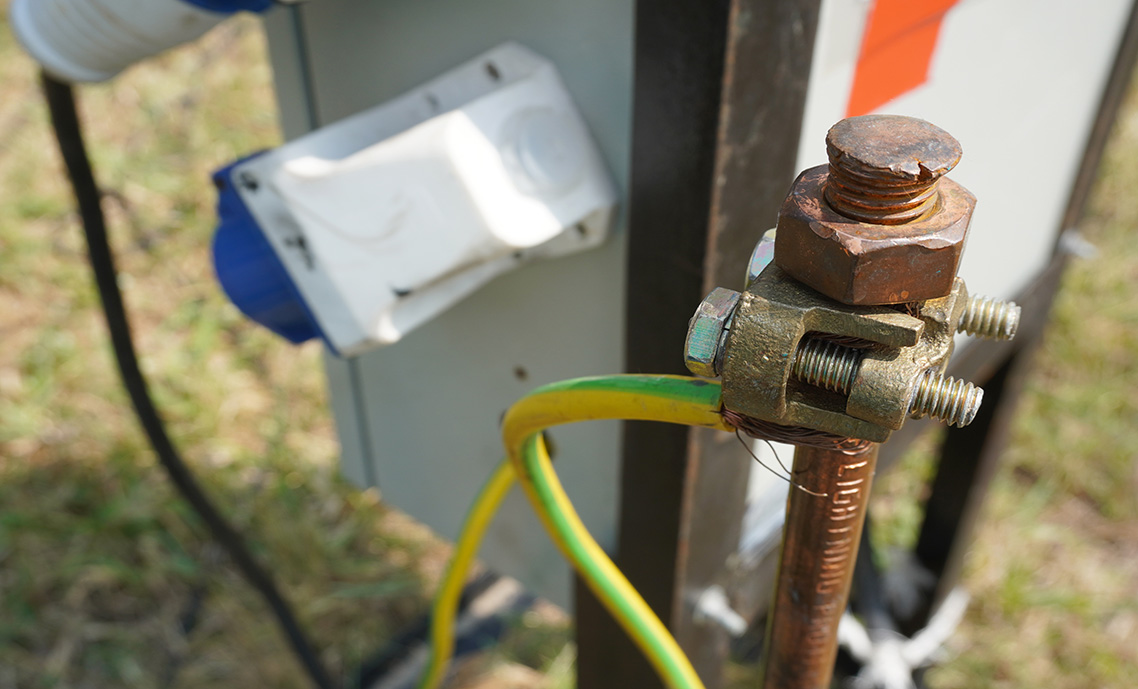
- Grounding lugs: Terminate conductors to strut, tray, or enclosures. Use UL 467-listed lugs with two-hole spacing per BICSI and TIA for secure, inspection-ready terminations.
- Bonding jumpers: Flexible or solid conductors bridging metallic components.
- Bus bars (ground bars): Flat copper or aluminum bars used as centralized grounding points for racks, cabinets, and enclosures. Accept multiple terminations and support MAC workflows.
- Compression grounding connectors: Approved alternatives to exothermic welds, suitable for corrosive or direct burial environments. IEEE 837 compliance and installation considerations apply.
- Exothermic weld kits: Permanent grounding for high-current zones.
- Listed clamps and connectors: Ensure mechanical and electrical integrity. Use antioxidant joint compound at metal-to-metal interfaces to prevent corrosion and maintain conductivity.
- Paint-piercing teeth or washers: Maintain continuity on coated surfaces.
- Pedestal clamps: Required for raised floor bonding; connect floor pedestals to the grounding system to maintain equipotential continuity.
Each method must be selected based on environment, standards, and system type. Continuity depends on correct installation and verified connections.
Grounding Standards
4. Grounding standards to know
Note: NEC 2026 reorganizes several articles related to grounding and bonding. Legacy article numbers are shown for reference.
- NFPA 70 (NEC): Article 250: Grounding & Bonding, Article 725: Class 1–4 Circuits, Article 805: Communications Circuits (replaces portions of legacy 800), Article 840: Premises-Powered Broadband, Article 800: Communications Circuits (deprecated)
- ANSI/TIA-607-D: Telecom bonding infrastructure
- ANSI/BICSI N3-20: ICT bonding and grounding practices
- IEEE Std. 142 (Green Book): Industrial grounding logic
- IEEE Std. 837: Compression and exothermic connection criteria
- UL 467: Certification for grounding hardware
- EIA-310: Rack grounding and mounting logic
- NEBS GR-63 / GR-1089: Carrier-grade telecom grounding
- ISO/IEC 30129: International telecom grounding standard
Use these standards to verify hardware selection, termination methods, and system continuity. Compliance depends on alignment—not improvisation.
System Behavior
5. Why is grounding an active system, not just insurance?
Grounding plays an active role in surge protection, fault current dissipation, and electrostatic discharge (ESD) control. It’s integral to uptime, network performance, and equipment safety—not simply a passive lightning safeguard. Integration with surge protective devices (SPDs) and transient voltage suppressors is increasingly standard under NEC 242.
What to Ground or Bond
6. What should be grounded or bonded in a typical install?
Grounding and bonding apply to all metallic components that could carry fault current or differential voltage. The goal is equipotential continuity across trays, enclosures, and support structures.
- Cable trays: Bond across tray sections and to building steel to maintain fault current paths and meet applicable codes.
- Strut channel: Use grounding lugs or jumpers across coated or isolated sections; powder-coated strut requires paint-piercing washers or dedicated bonding hardware.
- Conduit systems: EMT and rigid conduit must be bonded at junctions and terminations; verify continuity across connections.
- Cabinets, racks, and enclosures: Use internal bus bars or grounding lugs; bond to building steel or central ground bar, following rack grounding standards. Use antioxidant joint compound at all metal-to-metal interfaces.
- Patch panels and switches: Bond if manufacturer requires; verify continuity.
- Equipment frames and mounting hardware: Bond exposed metallic parts to prevent differential voltage buildup.
- Shielded cabling: Bond shields at one end only—typically at the patch panel or equipment side—to prevent ground loops and EMI. Follow manufacturer guidance for STP, FTP, coaxial, or hybrid cable types.
- Raised floor systems: Bond floor pedestals using listed pedestal clamps to maintain equipotential continuity across the floor grid.
Each bonded component contributes to system integrity. Missed connections or incompatible hardware compromise continuity and code compliance.
Failure Modes
7. What causes grounding and bonding failures?
Failures stem from overlooked connections, incompatible materials, or improper installation. These issues disrupt fault paths and compromise system integrity.
- Loose or corroded connections
- Unlisted or incompatible hardware
- Missing jumpers across isolated metallic sections
- Paint or powder coating blocking conductivity
- Ground loops from dual-ended shield bonding
- Failure to test continuity after install
- Improper conductor sizing or routing
- Overloaded bus bars or undocumented terminations
Prevent failure by verifying every connection, using listed hardware, and testing continuity before closeout. Field integrity depends on disciplined installation and inspection logic.
Labeling and Documentation
8. How do you label and document bonding systems?
Labeling and documentation ensure traceability, support inspections, and simplify MAC workflows. Every grounding point should be clearly identified and tied to system logic. Label grounding points by zone and system—e.g., “Zone 2: Signal Tray Bonded to Building Steel.” Documentation should include conductor size, termination method, hardware type, and test results. Bus bars should be labeled with system type and termination count. Clear documentation supports compliance, maintenance, and future changes.
Future Direction
9. What’s next for grounding and bonding hardware?
Grounding hardware is evolving toward smarter, faster, and more traceable systems. Smart lugs with torque indicators, QR-coded continuity tags, and BIM-integrated grounding maps are emerging. Some systems now include visual fault indicators, modular bonding kits, and pre-terminated jumpers for rapid deployment. Bus bars may include integrated surge protection or monitoring logic. These advancements aim to reduce installation errors, improve traceability, and align grounding systems with modern infrastructure demands.
Grounding and bonding aren’t optional—they’re foundational. Use this guide to verify continuity, select compliant hardware, and align with the standards that hold.
The information provided in this FAQ is for general informational purposes only and is not intended to replace official codes, standards, or project specifications. Winnie Industries products must always be installed and used in accordance with our product instruction sheets or designated training. Products should never be applied beyond their intended purpose or in a manner that exceeds specified load ratings. Proper fastening is critical to system integrity and functionality, requiring secure attachment to structurally sound components capable of supporting imposed loads. All installations must comply with governing codes, regulations, and job site requirements. Always consult your Authority Having Jurisdiction (AHJ) for specific regulatory guidance.