

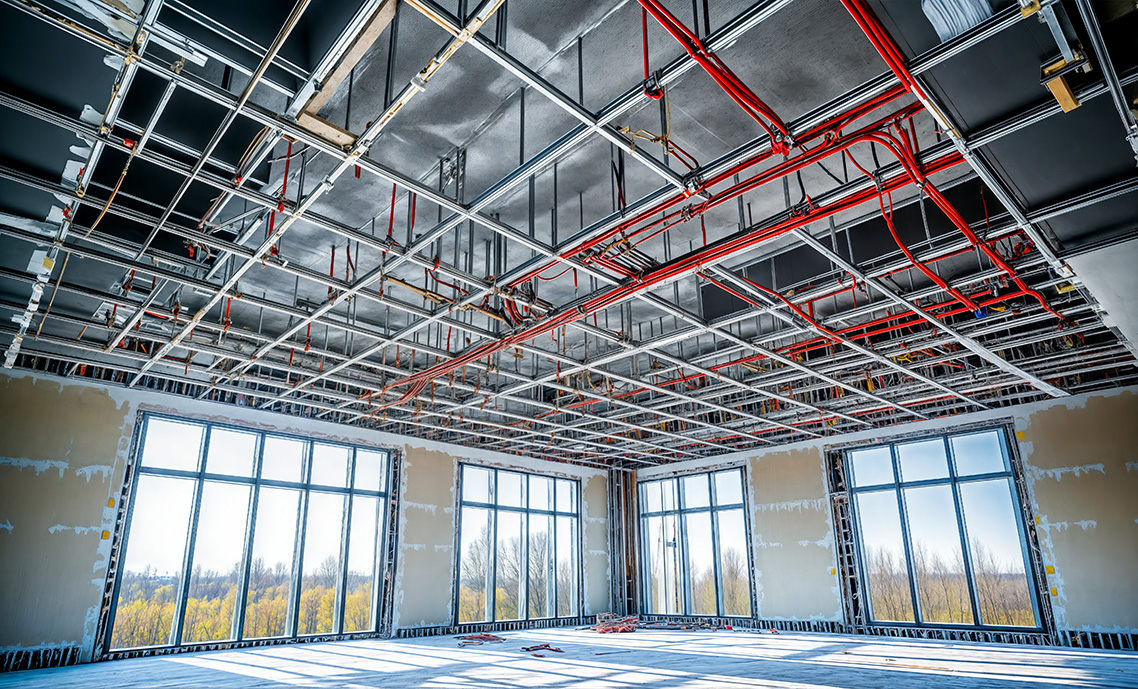
Where the Red Route Rules
A dedicated fire alarm pathway brings clarity and consistency to overhead spaces in commercial buildings, industrial facilities, and multi‑dwelling units (MDUs). By keeping life‑safety wiring clearly identified and isolated, the pathway stays easy to trace, inspect, and maintain throughout the life of the system. In open‑ceiling environments and dense low‑voltage areas, this separation helps prevent cross‑system interference and keeps fire alarm wiring from getting lost among electrical, IT, and mechanical infrastructure. Strong routing discipline also supports long‑term cable management and reinforces the reliability and code expectations that modern fire alarm and life‑safety installations demand.
The following sections outline how dedicated fire alarm pathways help maintain clear routing, proper separation, and dependable performance for life‑safety wiring throughout a building.
1. Establish a Fire Alarm Pathway That Stands Alone
A dedicated fire alarm pathway begins with the expectation that fire alarm wiring travels on its own. This separation creates order from the start, giving the system a clear identity and preventing the clutter that comes from shared supports. When the pathway stands alone, the rest of the installation follows suit—cleaner routing, clearer organization, and a structure every trade can immediately recognize.
2. Define a Dedicated Fire Alarm Pathway
A dedicated fire alarm pathway is a clearly identified, physically separated route used exclusively for fire alarm wiring. It keeps SLC, NAC, control, and auxiliary circuits isolated from every other system in the building. This isolation ensures that fire alarm wiring remains traceable, protected, and compliant from the moment it leaves the panel to the last device in the field.
A fire alarm pathway is considered dedicated when:
- Only fire alarm wiring is present
- The supports are consistently identifiable
- The route is predictable and easy to trace
- The pathway is protected from interference and congestion
- AHJs can verify compliance at a glance
A dedicated pathway is the foundation of clean, compliant fire alarm installation. Every other best practice — routing, color coding, survivability, inspection — builds on this principle.
3. Understand Why Dedicated Fire Alarm Pathways Matter
Fire alarm systems depend on wiring that must remain functional and identifiable under all conditions. When fire alarm circuits share supports with unrelated systems, it becomes harder to trace wiring, verify separation, and maintain survivability. Mixed pathways lead to rework, inspection delays, and confusion during troubleshooting.
A dedicated fire alarm pathway:
- Keeps life‑safety circuits isolated from unrelated wiring
- Reduces installation errors and misrouting
- Supports survivability requirements for critical circuits
- Simplifies AHJ inspections
- Maintains clarity during maintenance and upgrades
- Prevents other trades from occupying fire alarm supports
A clean pathway is more than a best practice — it is a direct contributor to system reliability and inspection success.
4. Identify Fire Alarm Pathway Types
Fire alarm systems use multiple circuit types, each with specific routing expectations. A dedicated pathway keeps these circuits organized and prevents them from being mixed with other building systems.
Common fire alarm pathway types include:
- Signaling Line Circuits (SLC)
- Notification Appliance Circuits (NAC)
- Power‑limited control circuits
- Auxiliary fire alarm circuits
- Elevator recall and shunt‑trip control
- Smoke control wiring
- Firefighter telephone circuits
- Emergency voice/alarm communication (EVACS)
- Mass notification (MNS)
5. Apply Fire Alarm Pathway Color Coding
Color coding is one of the most effective ways to maintain routing discipline and prevent cross‑system mixing. Red is universally recognized as the color of fire alarm and life‑safety systems, and using red hardware creates a pathway that stands out immediately in any ceiling environment.
Red supports provide instant clarity — whether they are j hooks, bridle rings, conduit, cable tags, pathway markers, or raceway labels — the red finish makes the system unmistakable.
Red j hooks, red bridle rings, and other red hardware do more than identify the system; they create a visual boundary that other trades instinctively respect. When the supports are red, electricians, IT, security, and AV crews know not to use them. This prevents mixed systems, reduces rework, and keeps the fire alarm pathway clean and compliant from the moment it is installed.
Red identification also speeds AHJ inspections. A red pathway can be verified in seconds, even in congested ceilings, because the system identity is unmistakable.
6. Apply NEC & NFPA Requirements for Fire Alarm Pathways
Fire alarm pathways must comply with NEC 760 and NFPA 72 requirements for separation, identification, and survivability. These standards emphasize clarity, isolation, and protection from mechanical or electrical interference.
Key expectations include:
- Physical separation from other systems
- Clear identification of fire alarm wiring
- Protection from mechanical damage
- Proper spacing from power circuits
- Survivability for critical circuits (Level 2 or Level 3)
- No mixing of unrelated systems in the same support
Red identification directly supports these requirements by making the fire alarm pathway visually distinct and easy to verify. AHJs can confirm separation and routing at a glance, reducing inspection time and eliminating ambiguity.
7. Apply Best Practices for Fire Alarm Pathways
A clean, consistent fire alarm pathway is one of the strongest indicators of a well‑installed system. Installers and AHJs consistently emphasize the importance of predictable routing, clear identification, and strict separation from other trades.
Best practices include:
- Keep fire alarm pathways isolated from all other systems
- Use straight, predictable routing with minimal transitions
- Maintain consistent support spacing
- Avoid congested areas that increase the risk of damage
- Keep pathways accessible for inspection
- Use color coding to reinforce system boundaries
- Prevent other trades from using fire alarm supports
Red identification reinforces these practices by making the pathway obvious and unambiguous. When the supports are red, the pathway stays clean — not because someone polices it, but because every trade immediately understands what it is.
8. Use the Correct Cable Management Components for Fire Alarm
Fire alarm pathways rely on hardware that supports clarity, separation, and survivability. The components used must maintain system identity and prevent accidental mixing with unrelated wiring.
Common components include:
- J Hooks
- Bridle Rings
- Conduit (EMT, Rigid, IMC)
- Conduit Clamps
- Fire Rated Cable Tray
- MI Cable Supports
- Strut Clamps
- Beam Clamps
- Seismic Rated Fasteners
- Raceway Supports
Red identification is especially valuable in open‑ceiling environments where conduit is not required. It provides a fast, compliant, and visually distinct pathway that keeps fire alarm wiring organized and unmistakable from the moment it is installed.
9. Identify Environmental Conditions Where Dedicated Fire Alarm Pathways Matter
Fire alarm pathways must remain clear and identifiable in every type of ceiling environment. Different spaces introduce different challenges, and a dedicated pathway — especially one built with red supports — helps maintain clarity across all conditions.
Key environments include:
- Open ceilings where multiple trades share overhead space
- Plenum spaces where airflow and mechanical congestion increase risk
- Healthcare facilities with dense low‑voltage infrastructure
- Industrial areas with vibration, dust, and mechanical hazards
- Mixed‑use ceilings where IT, security, AV, and electrical systems overlap
- Retrofit environments where existing pathways are unclear or undocumented
In all of these conditions, red j hooks and red bridle rings provide instant visual identification, reducing confusion and preventing other trades from occupying the fire alarm pathway.
10. Reference the Glossary for Fire Alarm Pathway Terms
AHJ — Authority Having Jurisdiction responsible for enforcing code compliance and approving fire alarm installations.
Auxiliary Fire Alarm Circuits — Control circuits used for fire‑related functions such as door release, fan shutdown, damper control, or elevator interface.
Dedicated Fire Alarm Pathway — A routing method reserved exclusively for fire alarm wiring, physically separated from all other building systems.
Elevator Recall / Shunt‑Trip Control — Fire alarm circuits that trigger elevator recall or disconnect power to elevator equipment during alarm or heat conditions.
EVACS — Emergency Voice/Alarm Communication System providing voice evacuation instructions and emergency messaging.
Firefighter Telephone Circuits — Wiring used for firefighter communication handsets within buildings.
Mass Notification System (MNS) — System used to deliver emergency messages during non‑fire events such as security threats or severe weather.
NAC — Notification Appliance Circuit powering horns, strobes, speakers, and other notification appliances.
Red Identification — Use of red‑colored hardware, labels, or markers to visually identify fire alarm pathways.
SLC — Signaling Line Circuit used for addressable fire alarm devices such as detectors, modules, and pull stations.
Survivability — Code‑defined requirements (Level 2 / Level 3) for maintaining circuit functionality during fire conditions.
Dedicated circuits anchor the integrity of life safety systems, ensuring that each critical function operates in isolation—uninterrupted, inspectable, and code-compliant when it matters most.
This guide is intended for informational and reference purposes only. It does not supersede local codes, manufacturer specifications, or the judgment of the Authority Having Jurisdiction (AHJ). Installation practices must always be verified against current NEC, ANSI/TIA standards, and site-specific requirements. Winnie Industries products must be installed and used in accordance with official instruction sheets or designated training. Products should never be applied beyond their intended purpose or in a manner that exceeds specified load ratings. Proper fastening is critical to system integrity and functionality, requiring secure attachment to structurally sound components capable of supporting imposed loads. All installations must comply with governing codes, regulations, and job site requirements. Always consult your AHJ for specific regulatory guidance.