

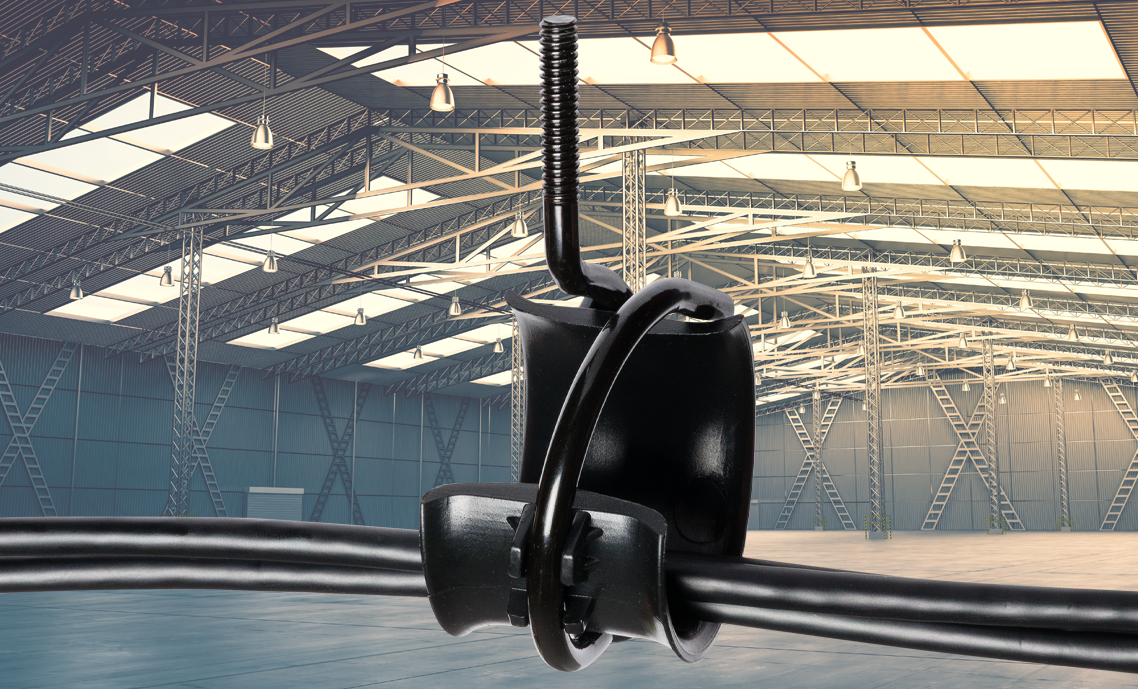
Where Bends Stay Friendly
Saddled bridle rings add a molded plastic saddle that spreads the load and prevents sharp‑radius pressure on the cable. This controlled support is important for CAT6A, fiber, and shielded cabling, which can deform or lose performance when forced into tight bends. Saddled rings are commonly used in open‑ceiling spaces, long horizontal runs, and anywhere bend‑sensitive cable needs low‑pressure support without the cost or complexity of a full tray system. They’re the preferred choice whenever maintaining cable shape and signal integrity is more important than simply suspending the run.
This guide outlines when saddled bridle rings must be used and how their saddle design protects bend‑sensitive and jacket‑sensitive cabling.
1. What Saddled Bridle Rings Are Designed to Protect
Saddled bridle rings use a molded support surface to protect bend‑sensitive and jacket‑sensitive cable types by distributing load across a wider area and maintaining cable geometry.
Why It Matters:
High‑performance cable types lose signal integrity when compressed or distorted. A narrow metal ring can flatten cable geometry, introduce microbending, or create long‑term jacket stress. Saddled rings prevent these issues by spreading the load and preserving the cable’s intended shape.
Best Practice:
Use saddled rings whenever cable protection is required for performance, inspection, or long‑term reliability. Select AH‑2 plenum‑rated saddled rings in air‑handling spaces to meet fire‑safety requirements.
2. Cable Types That Require Saddled Support
Cables with sensitive geometry or layered construction benefit from the saddle’s wider support surface, which reduces jacket compression and preserves electrical performance.
Why It Matters:
CAT6A, shielded twisted‑pair, fiber optic, and multi‑conductor control cables are more vulnerable to deformation. Even minor compression can change impedance, increase attenuation, or damage fiber strands. Saddled rings maintain the cable’s intended shape and reduce performance risk.
Best Practice:
Use saddled rings for CAT6A (UTP and STP), fiber optic cable, STP/FTP, and multi‑conductor control cable. For mixed bundles, size the ring to avoid stacking or pinching.
3. When Bend‑Radius Protection Is Required
The saddle maintains a smooth, controlled curvature that prevents tight bends, kinks, and microbending—conditions where bend‑radius protection becomes mandatory for performance.
Why It Matters:
Bend‑radius violations degrade signal quality, especially in CAT6A and fiber. A narrow ring concentrates force at a single point, increasing the risk of deformation. Saddled rings distribute the load and maintain proper curvature where bend‑radius protection is required by cable design or installation conditions.
Best Practice:
Use saddled rings in long horizontal runs, vertical drops, and direction changes. Select ring sizes that exceed the minimum bend radius for the cable type to prevent performance loss.
4. When Jacket Protection Is Essential
The saddle reduces abrasion, compression, and point‑pressure damage—conditions where jacket protection is essential for long‑term cable reliability.
Why It Matters:
Jacket deformation can lead to long‑term stress, premature wear, or failure during inspection. Heavy bundles or armored cables place more weight on each support point, increasing the risk of damage when using standard rings. Saddled rings provide the wider surface area needed to protect the jacket in these essential scenarios.
Best Practice:
Use saddled rings for armored fiber, multi‑conductor control cable, and large bundles. Ensure the saddle fully supports the cable without sharp transitions or edge contact, especially in long spans or exposed routing.
5. When Installations Are Reviewed or Inspected
Saddled rings support clean, compliant routing that maintains cable shape and reduces stress points—key factors in specification‑driven or inspected installations.
Why It Matters:
Inspectors look for proper support, bend‑radius protection, and avoidance of point pressure. Saddled rings reduce the risk of rejection during walkthroughs or design reviews. In plenum spaces, AH‑2 saddled rings are required to meet fire‑safety rules.
Best Practice:
Use saddled rings in any installation with consultant oversight, AHJ review, or strict cable‑handling requirements. Always select AH‑2 saddled rings in air‑handling spaces.
6. Where Saddled Bridle Rings Are Most Commonly Used
Saddled rings are used in commercial and institutional environments where cable protection and bend‑radius control matter but full tray systems are not required.
Why It Matters:
Open‑ceiling environments, long spans, and exposed routing increase the risk of cable deformation. Saddled rings provide controlled support without the cost or complexity of tray systems, making them ideal for everyday structured cabling.
Best Practice:
Use saddled rings in warehouses, schools, hospitals, commercial buildings, and anywhere CAT6A, fiber, or shielded cabling is routed across open structures or long horizontal runs.
7. When Standard Bridle Rings Are Not Acceptable
Standard rings create a narrow contact point that can distort cable shape, violate bend‑radius requirements, and introduce long‑term stress—making them unsuitable for many modern cable types.
Why It Matters:
CAT6A, fiber, and shielded cables cannot tolerate point pressure. Standard rings increase the risk of attenuation, microbending, jacket wear, and performance loss. In vibration or thermal‑cycling environments, these stresses worsen over time.
Best Practice:
Use saddled rings whenever cable performance, inspection requirements, or long‑term reliability are priorities. Avoid standard rings for bend‑sensitive or jacket‑sensitive cable types.
Saddled bridle rings are not a premium upgrade—they’re a mechanical necessity for preserving signal integrity, passing inspection, and protecting every CAT6A and fiber run from day one.
This guide is intended for informational and reference purposes only. It does not supersede local codes, manufacturer specifications, or the judgment of the Authority Having Jurisdiction (AHJ). Installation practices must always be verified against current NEC, ANSI/TIA standards, and site-specific requirements. Winnie Industries products must be installed and used in accordance with official instruction sheets or designated training. Products should never be applied beyond their intended purpose or in a manner that exceeds specified load ratings. Proper fastening is critical to system integrity and functionality, requiring secure attachment to structurally sound components capable of supporting imposed loads. All installations must comply with governing codes, regulations, and job site requirements. Always consult your AHJ for specific regulatory guidance.