

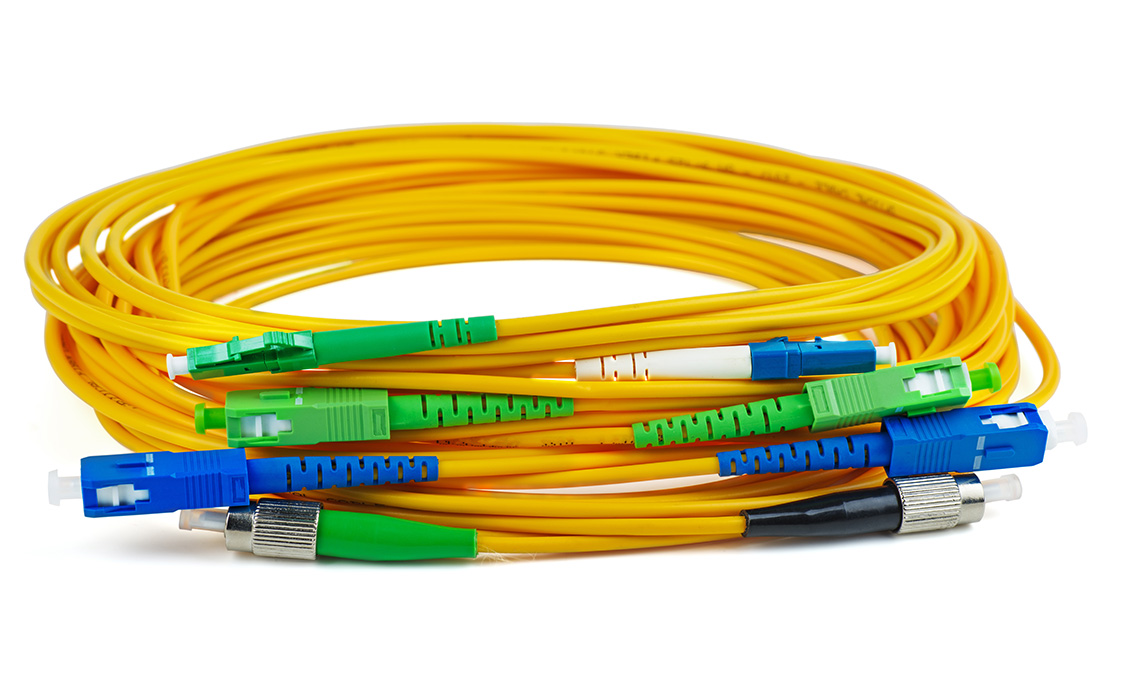
Glass, Light, and a Little Less Panic
Fiber optics can feel overwhelming at first — acronyms, colors, connector types, and jacket ratings all start to blend together when you’re trying to make sense of a cable run. At the core, though, fiber is simply light traveling through glass, carrying data at speeds and distances copper can’t match. Terms like OM3, OS2, OFNR, or LC show up everywhere, and each one points to a specific performance level or installation requirement. Understanding what these markings mean, how different fiber types behave, and where each one is typically used gives you the foundation to choose the right cable for any environment.
The next step is understanding the distinctions between the major fiber classifications and what each one is built to handle.
Multimode Fiber Overview
OM1
Technical Profile:
Multimode fiber with 62.5 µm core and 125 µm cladding. LED-based transmission at 850 nm and 1300 nm. Rated to 200 MHz·km @ 850 nm. Supports 10 Mb to 1 Gb Ethernet (~275 m at 1 Gb). Fails 10GBASE-SR beyond ~33 m. No longer recognized in current TIA-568 or ISO/IEC 11801 standards.
Deployment Environments:
Legacy campus networks and pre-2000 backbone runs
Retrofit zones with existing OM1 patch panels
Low-speed links in older commercial buildings
Short-range AV, control, or legacy LAN applications
Installer Consequences:
Orange jacket. LC, SC, or ST connectors. Limited bandwidth and modal dispersion risk. Bend radius must be managed in tight trays. Not compatible with MPO/MTP cassettes without adapter. OM1 jacket compounds may limit flexibility.
Specifier Accountability:
Obsolete for new builds. Do not spec for 10 Gb or beyond. Confirm jacket rating (OFNR/OFNP), polish type, and connector geometry. Label clearly and isolate from OM2–OM5 runs. Require attenuation and modal bandwidth documentation.
Connector Compatibility:
LC, SC, ST supported. Not compatible with MPO/MTP without adapter. Older OM1 links may use PC or UPC polish. Termination may require LED-optimized connector geometry.
OM2
Technical Profile:
Multimode fiber with 50 µm core and 125 µm cladding. LED-based transmission at 850 nm and 1300 nm. Rated to 500 MHz·km @ 850 nm. Supports 1 Gb Ethernet up to 550 m. Not suitable for 10 Gb beyond ~82 m. Numerical aperture: 0.20 ± 0.015.
Deployment Environments:
Mid-2000s commercial buildings and campus links
Retrofit zones with OM2 patch panels
Low-speed backbone runs with verified OM2 stock
Short-range AV, control, or legacy LAN applications
Installer Consequences:
Orange jacket. LC or SC connectors. Modal dispersion limits 10 Gb performance. Bend radius must be respected. Not compatible with MPO/MTP without adapter. Jacketed OM2 may lack flexibility compared to laser-optimized fiber.
Specifier Accountability:
Acceptable for 1 Gb only. Do not spec for 10 Gb or MPO deployments. Confirm jacket rating, polish type, and connector geometry. Label clearly and isolate from OM3–OM5 runs. Require attenuation and modal bandwidth documentation.
Connector Compatibility:
LC, SC supported. MPO requires adapter or cassette swap. Older OM2 links may use PC or UPC polish. Termination may require LED-optimized geometry.
OM3
Technical Profile:
Laser-optimized multimode fiber with 50 µm core and 125 µm cladding. Rated to 2000 MHz·km @ 850 nm. Supports 10 Gb up to 300 m and 40/100 Gb up to 100 m. Designed for VCSEL transmission. Bend-insensitive variants available.
Deployment Environments:
Data centers, telecom rooms, and backbone links
Commercial buildings with 10 Gb switches
MPO-based patching environments
Short-range aggregation zones and high-speed AV deployments
Installer Consequences:
Aqua jacket. LC or MPO connectors. Bend-insensitive variants reduce routing constraints. Must confirm polarity and strand count. Cassette compatibility must be validated. Requires laser-optimized cleaning protocols.
Specifier Accountability:
Acceptable for 10 Gb and short-range 40/100 Gb. Confirm jacket rating, bend radius, and cassette compatibility. Document polarity and strand count. Label clearly and isolate from OM1/OM2. Require attenuation and insertion loss documentation.
Connector Compatibility:
LC, MPO supported. SC and ST not recommended. MPO requires polarity documentation. Compatible with duplex and parallel optics.
OM4
Technical Profile:
Laser-optimized multimode fiber rated to 4700 MHz·km @ 850 nm. Supports 10 Gb up to 550 m and 40/100 Gb up to 150 m. Bend-insensitive variants standard.
Deployment Environments:
High-performance data centers and telecom rooms
MPO-based patching and cassette systems
Backbone links requiring extended 10 Gb reach
Parallel optics deployments
Installer Consequences:
Aqua or Erika Violet jacket. LC or MPO connectors. Bend-insensitive variants standard. Polarity and cassette mapping critical. Requires laser-optimized cleaning protocols.
Specifier Accountability:
Preferred for 10/40/100 Gb multimode. Confirm jacket rating, bend radius, and MPO cassette spec. Require polarity and insertion loss documentation. Label clearly and isolate from OM1–OM3.
Connector Compatibility:
LC, MPO supported. SC and ST not recommended. MPO requires polarity documentation. Supports duplex and parallel optics.
OM5
Technical Profile:
Wideband multimode fiber optimized for SWDM across 850–950 nm. Rated to 28000 MHz·km @ 850 nm. Supports 40/100 Gb up to 150 m. Bend-insensitive variants standard.
Deployment Environments:
Advanced data centers with SWDM transceivers
High-density MPO patching systems
Backbone links requiring wavelength multiplexing
Parallel optics and short-range aggregation layers
Installer Consequences:
Lime green jacket. LC or MPO connectors. Bend-insensitive. Polarity and strand mapping critical. Must confirm SWDM transceiver compatibility.
Specifier Accountability:
Use only where SWDM is deployed. Confirm jacket rating, cassette spec, and transceiver match. Require wavelength plan and insertion loss documentation. Label clearly and isolate from OM1–OM4.
Connector Compatibility:
LC, MPO supported. SC and ST not supported. MPO requires polarity documentation. Supports duplex and parallel optics.
Singlemode Fiber Overview
OS1
Technical Profile:
Singlemode fiber with 9 µm core. Indoor-rated (B1.1). Supports 1–100 Gb up to 10 km @ 1310 nm and 40 km @ 1550 nm. Attenuation ≤ 1.0 dB/km. Not bend-insensitive unless specified.
Deployment Environments:
Indoor backbones, telecom rooms, riser closets
Campus links and enterprise LAN uplinks
Installer Consequences:
Yellow jacket. LC or SC connectors. Laser safety required. Bend radius critical. Jacket must match fire code. Requires precise cleaning.
Specifier Accountability:
Acceptable for all indoor singlemode. Confirm jacket rating, connector type, polish geometry, and insertion loss. Document polarity and strand count. Label clearly and isolate from OS2.
Connector Compatibility:
LC, SC supported. MPO supported with proper cassette. APC may be required for RF overlay. Not compatible with multimode connectors.
OS2
Technical Profile:
Singlemode fiber with 9 µm core. Outdoor-rated (B1.3). Supports 1–100 Gb up to 10 km @ 1310 nm and 40+ km @ 1550 nm. Attenuation ≤ 0.4 dB/km. Bend-insensitive variants available.
Deployment Environments:
Outdoor backbones, campus links, direct burial, conduit, aerial, ISP infrastructure, municipal networks.
Installer Consequences:
Yellow jacket. LC or SC connectors. UV-resistant and water-blocking variants. Rodent-resistant armor optional. Bend radius and pulling tension critical.
Specifier Accountability:
Required for outdoor singlemode. Confirm jacket rating (UV, water-blocking, rodent-resistant). Document polarity and strand count. Label clearly and isolate from OS1.
Connector Compatibility:
LC, SC supported. MPO supported with proper cassette. APC may be required for RF overlay. Not compatible with multimode connectors.
Hybrid Fiber Cable (Power over Fiber) Overview
Composite Cable
Technical Profile:
Composite cable integrating optical fibers and copper conductors. Supports high-bandwidth data and low-voltage DC power. Fiber may be singlemode or multimode; copper typically 16–12 AWG. Jackets may be OFCR, OFCP, or OSP.
Deployment Environments:
Security cameras, WAPs, sensors, smart poles, kiosks, industrial automation, transit systems, tunnels, and constrained conduit environments.
Installer Consequences:
Larger OD and mixed termination requirements. Requires coordination between fiber and power crews. Bend radius and pulling tension must be managed. May require staggered termination zones.
Specifier Accountability:
Confirm fiber type, copper gauge, and jacket rating. Require documentation of power capacity and flame rating. Do not substitute standard fiber or copper. Label clearly and isolate from single-media bundles.
Connector Compatibility:
Fiber: LC, SC, MPO depending on strand count. Power: unterminated or DC barrel/Molex/custom. Strain relief protocols may be required.
Next‑Generation Fiber Technologies
Hollow‑Core Fiber (HCF)
Technical Profile:
Air‑filled core fiber using photonic bandgap or anti‑resonant structures to guide light. Delivers 30–50% lower latency than solid‑core silica. Extremely low nonlinearity and reduced chromatic dispersion. Early variants approaching OS2‑class attenuation.
Deployment Environments:
Hyperscale data centers and AI clusters
Financial trading networks requiring ultra‑low latency
Long‑haul and metro networks under upgrade
Research and early‑adoption backbone environments
Installer Consequences:
Specialized handling requirements. Bend radius more restrictive than G.657. Not compatible with standard fusion splicing equipment without adapters. Requires manufacturer‑approved termination kits. Jacket types vary by vendor.
Specifier Accountability:
Confirm attenuation, latency, and connectorization method. Require vendor‑specific splice loss documentation. Validate compatibility with DWDM systems. Do not mix with OS1/OS2 in the same path without engineered transitions.
Connector Compatibility:
Typically LC or SC with specialized ferrules. MPO variants emerging. APC may be required for certain architectures. Not compatible with multimode connectors.
Ultra‑Low‑Loss Fiber (ULL)
Technical Profile:
Enhanced singlemode fiber engineered for minimal attenuation. Variants of G.654.E or optimized G.652.D. Attenuation approaching 0.14 dB/km. Larger effective area reduces nonlinear effects and improves long‑haul performance.
Deployment Environments:
Long‑haul terrestrial networks
Subsea and coastal landing stations
AI backbone interconnects
High‑capacity metro rings
Installer Consequences:
Yellow jacket. LC or SC connectors. Larger mode field diameter may require tuned splicing parameters. Bend radius more restrictive than G.657. Requires precise cleaning and handling.
Specifier Accountability:
Confirm attenuation class, effective area, and splice compatibility with OS2. Require DWDM compatibility documentation. Label clearly and isolate from standard OS2 unless engineered.
Connector Compatibility:
LC, SC supported. MPO supported with tuned cassettes. APC recommended for long‑reach or RF overlay. Not compatible with multimode connectors.
Multi‑Core Fiber (MCF)
Technical Profile:
Fiber containing multiple independent cores within a single cladding. Supports space‑division multiplexing (SDM). Enables massive capacity increases without additional cable count. Crosstalk‑optimized designs emerging.
Deployment Environments:
Research networks and early carrier deployments
Dense metro rings and hyperscale backbones
AI cluster interconnects requiring extreme capacity
Installer Consequences:
Specialized splicing equipment required. Connectorization varies by vendor. Bend radius and pulling tension must be strictly controlled. Not compatible with standard cassettes or patch panels.
Specifier Accountability:
Require documentation of core count, crosstalk performance, and SDM compatibility. Confirm splice and connector ecosystem. Do not mix with OS2 unless engineered transitions exist.
Connector Compatibility:
Specialized multi‑core connectors only. No LC/SC/MPO compatibility. Requires vendor‑specific termination hardware.
Few‑Mode Fiber (FMF)
Technical Profile:
Fiber supporting a small number of spatial modes for mode‑division multiplexing (MDM). Enables higher capacity without increasing wavelength count. Requires advanced DSP for mode separation.
Deployment Environments:
Research networks
Early‑stage metro and long‑haul trials
High‑capacity experimental backbones
Installer Consequences:
Handling similar to OS2 but requires mode‑aware test equipment. Splicing parameters must be tuned for modal alignment. Not compatible with standard transceivers.
Specifier Accountability:
Confirm mode count, MDM equipment compatibility, and splice loss requirements. Require documentation of modal dispersion and crosstalk. Do not mix with OS2.
Connector Compatibility:
Specialized connectors only. No LC/SC/MPO compatibility. Requires vendor‑specific termination.
Next‑Gen Bend‑Insensitive Fiber (G.657.A3)
Technical Profile:
Advanced bend‑insensitive singlemode fiber with tighter bend radius than G.657.A2. Optimized for ultra‑dense routing, micro‑ducts, and high‑density data center environments. Fully compatible with OS2 optical budgets.
Deployment Environments:
High‑density data centers
Micro‑duct and micro‑cable systems
MDUs and tight‑radius conduit environments
Installer Consequences:
Yellow jacket. LC or SC connectors. Extremely forgiving bend radius but still requires proper routing. Compatible with standard splicing equipment.
Specifier Accountability:
Confirm G.657.A3 rating. Validate compatibility with OS2 budgets. Require documentation of bend radius and insertion loss. Label clearly and isolate from older OS1 unless tested.
Connector Compatibility:
LC, SC supported. MPO supported with standard cassettes. APC recommended for long‑reach or RF overlay.
Fiber Jacket Types
OFNR (Optical Fiber Nonconductive Riser)
Description:
Rated for vertical runs between floors in non-plenum spaces. Flame-retardant but not smoke-rated.
Use Case:
Riser closets, telecom rooms, conduit-protected backbone runs.
OFNP (Optical Fiber Nonconductive Plenum)
Description:
Rated for air-handling spaces such as drop ceilings and plenums. Highest flame and smoke resistance.
Use Case:
Required in exposed plenum environments including return-air plenums.
LSZH (Low Smoke Zero Halogen)
Description:
Emits minimal smoke and no halogen gases when burned, reducing toxicity and corrosion risk.
Use Case:
Transit systems, tunnels, and global deployments with environmental toxicity constraints.
OSP (Outside Plant)
Description:
Jacketed for direct burial, aerial, or conduit installations. UV-resistant, water-blocking, and rodent-resistant variants available.
Use Case:
Outdoor backbones, campus links, and inter-building fiber routes.
Armored
Description:
Includes interlocking steel or corrugated aluminum armor for crush resistance and rodent protection.
Use Case:
Industrial zones, transit tunnels, and exposed conduit runs. May be riser-rated (OFCR) or plenum-rated (OFCP).
From first splice to final spec, this FAQ gives you the language, logic, and layout to navigate fiber cabling with confidence — whether you're on the jobsite or just starting out.
The information provided in this FAQ is for general informational purposes only and is not intended to replace official codes, standards, or project specifications. Winnie Industries products must always be installed and used in accordance with our product instruction sheets or designated training. Products should never be applied beyond their intended purpose or in a manner that exceeds specified load ratings. Proper fastening is critical to system integrity and functionality, requiring secure attachment to structurally sound components capable of supporting imposed loads. All installations must comply with governing codes, regulations, and job site requirements. Always consult your Authority Having Jurisdiction (AHJ) for specific regulatory guidance.