

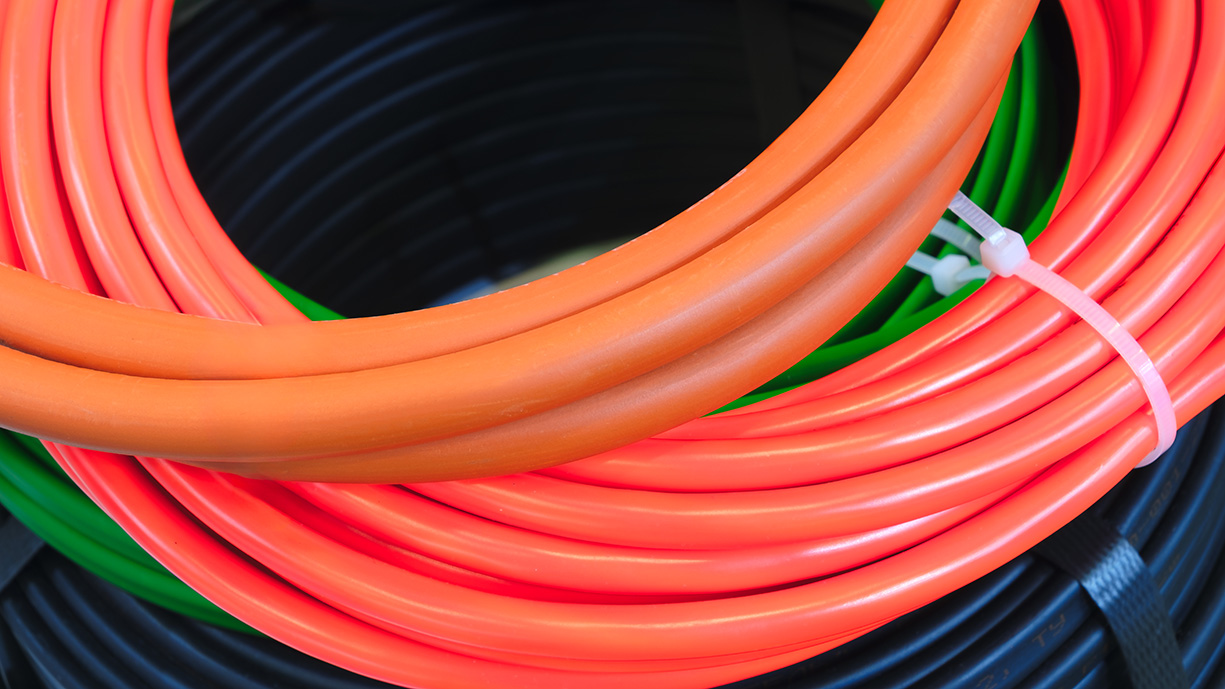
No Jacket, No Service
Cable jackets are everywhere—threaded through ceilings, buried outdoors, routed across machinery, and bundled behind telecom racks—yet jacket selection remains one of the most overlooked decisions in cable deployment. The jacket isn’t just a finish; it’s the functional boundary that determines where a cable can go, how long it will last, and whether it passes inspection. Each material brings its own mechanical traits, environmental tolerances, and compliance implications, governing everything from flame behavior and moisture resistance to flexibility and chemical stability. Choosing the wrong jacket introduces real deployment risk, leading to premature failure, inspection issues, or violations of NEC and UL requirements—not convenience or cost.
The guide below breaks down each jacket type by when to use it, why it’s selected, and where it belongs—ensuring every choice is grounded in standards alignment, environmental suitability, and real‑world field relevance
PVC (Polyvinyl Chloride)
A versatile, cost‑effective jacket material commonly used for indoor low‑voltage and telecom applications.
When to Use: For general indoor installations where the environment is controlled and mechanical or chemical exposure is minimal.
Why to Use: PVC offers a balanced combination of flexibility, abrasion resistance, and cost efficiency. It routes easily through bends, supports standard pulling tensions, and performs reliably in telecom rooms and riser pathways.
Where to Use: Interior building pathways, telecom closets, riser shafts, and low‑risk indoor zones where environmental exposure is limited.
PE (Polyethylene)
A durable, moisture‑resistant jacket designed for outdoor, underground, and aerial environments.
When to Use: Outdoor, underground, or aerial installations where moisture, UV exposure, and temperature swings are present.
Why to Use: PE provides excellent moisture resistance, UV stability, and ruggedness. It withstands freeze/thaw cycles, soil contact, and long‑term outdoor exposure without cracking or degrading.
Where to Use: OSP environments, underground conduits, direct‑burial runs, aerial spans, pedestals, and outdoor cabinets.
LSZH (Low Smoke Zero Halogen)
A low‑toxicity jacket engineered to limit smoke and halogen release during fire conditions.
When to Use: Enclosed or occupied spaces where reduced smoke and halogen output is required by environmental policy, customer specification, or international standards.
Why to Use: LSZH minimizes toxic smoke and corrosive gas release during combustion, improving survivability and reducing contamination risk in confined spaces.
Where to Use: Enclosed public areas, tunnels, transit systems, transportation hubs, and facilities with strict air‑quality or toxicity requirements.
PUR (Polyurethane)
A rugged, high‑flex jacket built to withstand abrasion, vibration, and continuous mechanical stress.
When to Use: High‑flex, high‑abrasion, or vibration‑prone environments where cables are subject to repeated movement or mechanical stress.
Why to Use: PUR offers superior cut resistance, abrasion resistance, and chemical durability. It maintains flexibility under continuous motion and resists oils, solvents, and mechanical wear better than PVC or PE.
Where to Use: Robotics, automated machinery, conveyor systems, mobile equipment, and industrial zones with constant motion or mechanical impact.
TPE (Thermoplastic Elastomer)
A flexible, elastic jacket formulated for dynamic routing, cold‑weather handling, and temporary setups.
When to Use: Temporary installs, mobile equipment, or cold‑weather routing where tight bends and repeated repositioning are expected.
Why to Use: TPE provides exceptional flexibility, elasticity, and low‑temperature performance. It handles tight bend radii, dynamic routing, and frequent handling without cracking or stiffening.
Where to Use: Temporary cabling setups, field testing environments, mobile platforms, retrofit installations, and cold‑climate deployments.
FEP (Fluorinated Ethylene Propylene)
A high‑temperature, low‑friction jacket optimized for dense cable bundles and thermally demanding installations.
When to Use: High‑temperature, high‑density, or thermally demanding cable environments where heat buildup or airflow restrictions are present.
Why to Use: FEP delivers excellent thermal stability, low friction, and strong flame behavior. It supports high‑density bundles, elevated operating temperatures, and demanding data applications without deforming or degrading.
Where to Use: Data centers, high‑density cable trays, elevated‑temperature zones, and installations where thermal loading or airflow constraints are a concern.
XLPE (Cross‑linked Polyethylene)
A cross‑linked, heat‑resistant jacket offering strong electrical insulation and long‑term thermal stability.
When to Use: High‑temperature or electrically demanding environments where dielectric strength and thermal endurance are critical.
Why to Use: XLPE provides excellent electrical insulation, heat resistance, and mechanical stability. It resists cracking under thermal cycling and maintains structural integrity under elevated temperatures.
Where to Use: Power distribution systems, engine bays, industrial control panels, and electrically intensive environments.
PTFE (Polytetrafluoroethylene / Teflon)
A chemically inert, flame‑resistant jacket designed for extreme temperatures and contamination‑sensitive environments.
When to Use: Extreme chemical, thermal, or contamination‑sensitive environments requiring maximum material stability.
Why to Use: PTFE is chemically inert, flame‑resistant, and exceptionally stable under heat. It offers low friction, resists corrosive agents, and maintains performance in mission‑critical or sterile environments.
Where to Use: Aerospace systems, cleanrooms, corrosive industrial zones, laboratory environments, and mission‑critical installations.
Silicone
A highly flexible, heat‑tolerant jacket suitable for sterile, hygienic, or thermally extreme conditions.
When to Use: High‑temperature, flexible, or contamination‑sensitive environments where both heat resistance and pliability are required.
Why to Use: Silicone provides exceptional flexibility, thermal endurance, and microbial resistance. It remains pliable under extreme temperatures and is compatible with sterile or hygienic environments.
Where to Use: Medical facilities, cleanrooms, foodservice zones, aerospace applications, and environments requiring high flexibility and thermal stability.
Specialty Jackets (Rodent‑Resistant, Armored, Oil‑Resistant, Sunlight‑Resistant)
Application‑specific jackets engineered to resist rodents, crushing, oils, chemicals, or long‑term sunlight exposure.
When to Use: When the installation environment presents physical, chemical, or outdoor exposure risks that exceed the protection offered by standard polymer jackets.
Why to Use: Rodent‑resistant and armored jackets prevent gnawing, puncture, crushing, and mechanical intrusion. Oil‑resistant jackets maintain structural integrity in petroleum‑exposed industrial spaces. Sunlight‑resistant jackets prevent UV‑driven cracking, brittleness, and jacket failure during long‑term outdoor exposure.
Where to Use: Industrial plants, food processing facilities, rooftops, exterior conduit runs, agricultural buildings, mechanical rooms, parking structures, and any environment with rodents, oils, chemicals, or direct sunlight.
The right jacket isn’t just a match—it’s a mandate; every cable must be selected for its environment, its demands, and its role in keeping the system compliant, durable, and inspection-ready.
This guide is intended for informational and reference purposes only. It does not supersede local codes, manufacturer specifications, or the judgment of the Authority Having Jurisdiction (AHJ). Installation practices must always be verified against current NEC, ANSI/TIA standards, and site-specific requirements. Winnie Industries products must be installed and used in accordance with official instruction sheets or designated training. Products should never be applied beyond their intended purpose or in a manner that exceeds specified load ratings. Proper fastening is critical to system integrity and functionality, requiring secure attachment to structurally sound components capable of supporting imposed loads. All installations must comply with governing codes, regulations, and job site requirements. Always consult your AHJ for specific regulatory guidance.