

Magnetic Terms That Stick
Magnets play a critical role across industries—from mounting and fastening to sensing, alignment, and structural support. Their performance depends on understanding how different materials respond to magnetic fields, how magnet shapes influence force and stability, and how environmental conditions affect long‑term reliability. Whether you’re selecting hardware for everyday tasks or specifying components for demanding applications, knowing the terminology leads to smarter choices and safer, more predictable installations.
To support clearer decision‑making and safer applications, the glossary below defines essential magnetic terms—covering materials, types, forces, and field behavior.
Magnet Types & Geometries
Arc Magnet: A curved segment of a ring magnet used in motors and rotary magnetic assemblies.
Bar Magnet: A rectangular magnet with poles on opposite ends used in educational demos and basic field alignment.
Block Magnet: A rectangular prism magnet similar to bar magnets but often larger and used in industrial fixtures.
Cone Magnet: A tapered magnet with focused field geometry used in specialty applications requiring directional pull.
Cylinder Magnet: A long, round magnet with poles on flat ends used in deeper mounting wells and magnetic rods.
Disc Magnet: A flat, cylindrical magnet with poles on the circular faces used in mounting pads, cable holders, and cup assemblies.
Horseshoe Magnet: A U‑shaped magnet designed to concentrate magnetic field strength across a narrow gap.
Ring Magnet: A donut‑shaped magnet with a central hole used in sensors, motors, and axial mounting configurations.
Spherical Magnet: A ball‑shaped magnet with uniform field distribution used in magnetic toys, closures, and low‑load applications.
Magnetic Physics & Field Behavior
Air Gap: The space between a magnet and the mounting surface, which reduces holding force if not minimized.
BH Curve (Demagnetization Curve): A graph showing how a magnet responds to external magnetic fields, used to evaluate material stability and performance.
BH Max (Maximum Energy Product): The point on the BH curve representing the magnet’s maximum strength, used to define grades like N52.
Br Max (Residual Induction): The magnetic field remaining after external magnetizing force is removed, indicating maximum flux output.
Coercive Force (Hc): The magnetic field strength required to demagnetize a magnet, measured in Oersteds.
Curie Temperature: The temperature at which a magnet permanently loses its magnetic properties.
Demagnetization: Loss of magnetic strength due to heat, shock, or opposing magnetic fields.
Diamagnetic Material: A material repelled by magnetic fields and difficult to magnetize, such as copper, bismuth, and graphite.
Electromagnet: A temporary magnet activated by electric current, used in lifting systems and industrial switching.
Ferromagnetic Material: A material easily magnetized and strongly attracted to magnets, including iron, steel, cobalt, and Alnico.
Field Strength Gradient: The rate at which magnetic field strength changes across space, affecting pull force distribution.
Flux Density (Gauss): A measure of magnetic field strength at a specific point.
Hysteresis Loop: A graph showing how a magnetic material responds to magnetizing and demagnetizing forces.
Magnetic Failure Zone: Environments where heat, oil, or non‑ferrous surfaces reduce magnetic effectiveness.
Magnetic Field Lines: Invisible lines representing the direction and strength of a magnetic field.
Magnetic Force: The physical force exerted by a magnetic field on ferromagnetic materials or moving charges.
Magnetic Law: The principle that like poles repel and unlike poles attract.
Magnetic Pole: The region of a magnet where the field is strongest, typically labeled North and South.
Magnetic Saturation: The point at which a magnetic material cannot hold additional magnetic flux.
Paramagnetic Material: A material weakly attracted to magnets, such as aluminum or platinum.
Permanent Magnet: A magnet that retains its magnetic field without external power.
Residual Magnetism: The lingering magnetic field in a surface after a magnet is removed.
Shear Force: The horizontal resistance to sliding, important in vibration‑prone installations.
Magnet Materials & Composition
Alnico: A magnet alloy made from aluminum, nickel, and cobalt, stable at high temperatures but weaker than neodymium.
Barium Ferrite: A ferrite material used in ceramic magnets, offering corrosion resistance and moderate strength.
Boron (B): A key element in NdFeB magnets that enables the Nd₂Fe₁₄B crystal structure.
Cobalt (Co): A metal used in SmCo and Alnico magnets for high temperature stability.
Copper (Cu): A metal used in Alnico alloys and bonded magnets to improve conductivity and stability.
Dysprosium (Dy): A rare‑earth element added to NdFeB magnets to improve high‑temperature performance.
Iron (Fe): The primary metal in NdFeB and ferrite magnets.
Neodymium (Nd): A rare‑earth element used in NdFeB magnets for extremely high magnetic strength.
Nickel (Ni): A metal used in Alnico magnets and protective coatings for corrosion resistance.
Praseodymium (Pr): A rare‑earth element blended with neodymium to improve availability.
Samarium (Sm): A rare‑earth element used in SmCo magnets for excellent thermal stability.
Samarium Cobalt (SmCo): A rare‑earth magnet material with high temperature resistance and corrosion stability.
Strontium Ferrite: A ferrite compound used in ceramic magnets for low‑cost magnetic performance.
Terbium (Tb): A rare‑earth element used in high‑temperature NdFeB magnets.
Manufacturing Orientation & Structure
Anisotropic Magnet: A magnet with a preferred magnetization direction that offers higher performance.
Isotropic Magnet: A magnet with no preferred magnetization direction that can be magnetized in any orientation.
Magnetization Direction: The axis along which a magnet is most effectively magnetized.
Sintered Magnet: A magnet formed by pressing and heating powdered material.
Mounting Behavior & Application Performance
Flexible Magnet: A magnet made from ferrite powder and polymer binder used in signage and low‑strength applications.
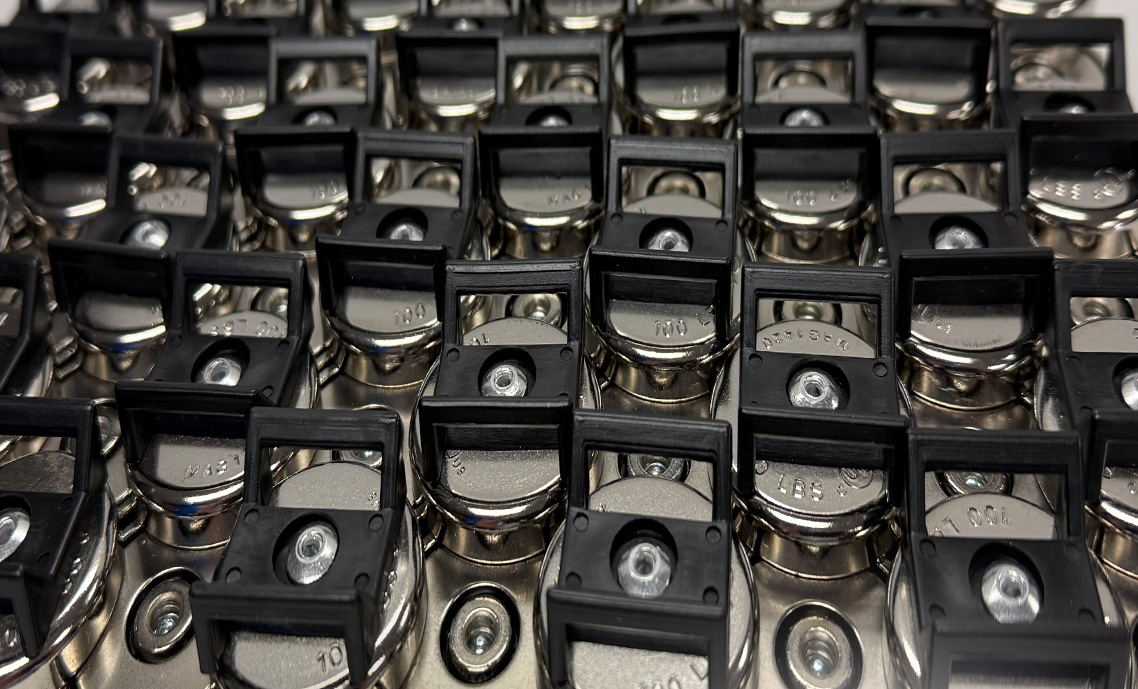
Magnet Cup (or Cup Assembly): A steel casing that surrounds a magnet to concentrate and direct its magnetic field.
Magnetic Base: The foundational magnetic component used to anchor accessories.
Mounting Orientation: The direction a magnet is applied relative to its poles and the surface.
Mounting Substrate Compatibility: The ability of a surface to support magnetic adhesion based on ferrous content and coatings.
Pull Force: The vertical force required to detach a magnet from a surface.
Repositionable Mount: A magnetic mount that can be relocated without residue or surface damage.
Rubber‑Coated Magnet: A magnet with a protective layer to prevent surface damage and improve grip.
Soft Magnetic Material: A metal that magnetizes easily but does not retain magnetism.
Temporary Magnet: A material that exhibits magnetism only while exposed to a magnetic field.
This glossary closes the loop on magnetic terminology, giving you a clear, field-ready reference for smarter selection, safer mounting, and specifier-grade precision.
The information provided in this FAQ is for general informational purposes only and is not intended to replace official codes, standards, or project specifications. Winnie Industries products must always be installed and used in accordance with our product instruction sheets or designated training. Products should never be applied beyond their intended purpose or in a manner that exceeds specified load ratings. Proper fastening is critical to system integrity and functionality, requiring secure attachment to structurally sound components capable of supporting imposed loads. All installations must comply with governing codes, regulations, and job site requirements. Always consult your Authority Having Jurisdiction (AHJ) for specific regulatory guidance.