

Don’t Call It a Closet
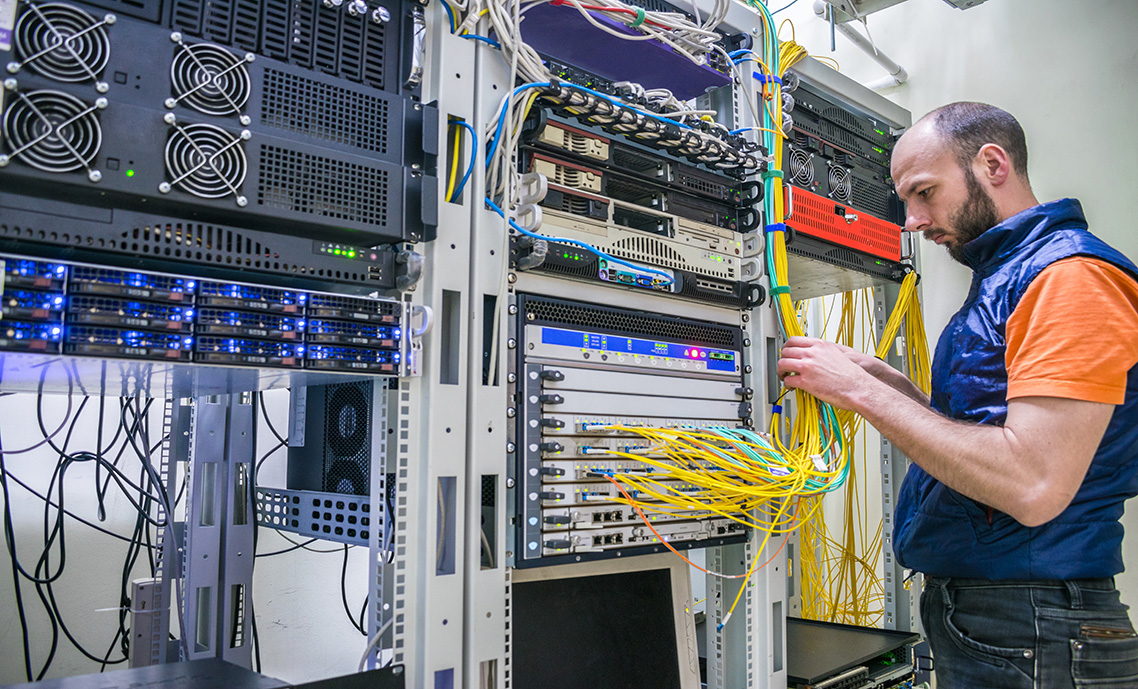
Telecom rooms are the backbone of structured cabling infrastructure—housing the equipment, terminations, and pathways that support voice, data, and video across commercial, educational, and institutional buildings. Proper design and deployment are critical to performance, compliance, and long-term serviceability. Every decision—from room placement and power isolation to cable dressing and inspection documentation—affects not just uptime, but the integrity of the entire network lifecycle. As centralized hubs for structured cabling, telecom rooms anchor copper, fiber, and low‑voltage systems and ensure reliable network distribution throughout the building.
This guide covers the most common questions that arise during planning, installation, and inspection—sequenced for clarity, code alignment, and readiness across ANSI/TIA, NEC, NFPA, and BICSI standards.
Telecom Room Definition and Placement Requirements
1. What is a telecom room, and how does it differ from an equipment room?
A telecom room (TR) is a secure, climate-controlled space that houses telecommunications equipment, cable terminations, and cross-connects for voice, data, and video. Unlike equipment rooms, which may serve multiple systems, TRs are dedicated to structured cabling and network distribution within a serving zone.
2. Where should telecom rooms be located within a building?
TRs should be centrally located within their serving zone to minimize cable runs. Avoid placing them near water sources, heat-generating equipment, or EMI sources like elevators, generators, or electrical closets.
3. Can telecom rooms be placed in basements, attics, or shared spaces?
No. TRs must not share space with janitor closets, electrical panels, or storage. Basements and attics are discouraged due to moisture, access, and environmental control risks.
4. What are the risks of locating telecom rooms near moisture or EMI sources?
Moisture can damage equipment and cabling. EMI from motors, generators, or elevators can interfere with signal integrity. TRs must be isolated from these hazards to maintain performance and compliance.
5. Should telecom rooms be stacked vertically across floors for cable alignment?
Yes. Stacking TRs directly above one another simplifies vertical cable management and riser alignment. Doors and pathways should be coordinated to avoid conflicts.
Telecom Room Sizing, Layout, and Spatial Clearances
1. How should telecom room size be determined for multi-floor buildings?
Size should reflect the floor area served. Guidelines include:
- 10×8 ft for ≤5,000 sq ft
- 10×9 ft for 5,000–8,000 sq ft
- 10×11 ft for 8,000–10,000 sq ft
2. What is the recommended minimum square footage for a telecom room?
A minimum of 100 square feet is recommended, with a 10×10 ft footprint preferred for flexibility and future expansion.
3. What ceiling height is required or preferred in telecom rooms?
Minimum ceiling height is 9–10 ft. In many cases, no ceiling is preferred—walls should extend to the structural deck above to allow open cable pathways and airflow.
4. What minimum clearance is required around racks and cabinets?
Maintain at least 36 inches in front and behind racks. Side clearance should be at least 6 inches from walls. These clearances support full access and code compliance.
5. Should telecom rooms have ceilings, or should walls extend to the structural deck?
Walls extending to the structural deck are preferred. This allows open cable pathways, better airflow, and easier integration with ladder trays and risers.
6. How should cable pathways be positioned for clean entry and management?
Cable openings should be placed above ceiling tiles or near the top of walls. Maintain 6" clearance below ceiling tiles and 12" above trays. J hooks should be spaced every 4 ft and limited to 30 cables each.
Power Distribution, Grounding, and Bonding Requirements
1. Is dedicated power required for telecom equipment?
Yes. TRs must have dedicated circuits—typically two 20A circuits per rack (normal + emergency). Power should be isolated from other building systems.
2. Should telecom rooms include redundant power and UPS backup?
Yes. Redundant power and an Uninterruptible Power Supply (UPS) are required to maintain uptime during outages or maintenance events.
3. Can telecom and electrical conduits share the same pathway?
No. Electrical and telecom conduits must be separated to prevent EMI and meet code requirements. Shared pathways are prohibited.
4. What bonding requirements apply to cable trays and racks?
All metallic components—including trays, racks, and cabinets—must be bonded to the Telecommunications Grounding Busbar (TGB), which connects to the building’s grounding backbone.
5. What is a Telecommunications Grounding Busbar (TGB), and how should it be installed?
The TGB is a centralized grounding point for telecom equipment. It must be bonded per ANSI/TIA-J-STD-607-B and NEC Article 250, and mounted on a fire-rated backer board 12" above the finished floor.
HVAC, Environmental Control, and Airflow Standards
1. What temperature and humidity ranges must be maintained in telecom rooms?
Maintain 64–75°F and 30–55% relative humidity. Sensors and alerts should be installed to monitor conditions.
2. Are telecom rooms required to have independent HVAC systems?
Yes. Each TR should have its own dedicated cooling system—either a standalone unit or a thermostat-controlled zone.
3. Can ventilation be shared with adjacent spaces?
No. TRs must not share ventilation with restrooms, janitor closets, or other non-technical spaces. Shared airflow can introduce contaminants and violate code.
Hardware, Racks, Cabinets, and Support Infrastructure
1. What is the difference between open-frame racks and enclosed cabinets?
Open-frame racks allow better airflow and easier access, while enclosed cabinets offer physical protection and security. Selection depends on equipment type and environmental needs.
2. When are wall-mount racks acceptable, and what are their limitations?
Wall-mount racks are acceptable for small deployments or edge devices. They must be securely anchored and allow sufficient clearance for cable management and airflow.
3. Are seismic-rated racks or cabinets required in certain buildings or regions?
Yes. In seismic zones or critical infrastructure buildings, racks and cabinets must meet seismic anchoring standards.
4. How should racks and cabinets be anchored for stability and compliance?
Use manufacturer-rated anchors and follow local building codes. Anchoring must resist tipping, vibration, and seismic forces.
5. What clearance is required around freestanding or wall-mounted hardware?
Maintain 36" front and rear clearance, and at least 6" side clearance from walls or adjacent equipment.
6. Are modular patch panels required for horizontal cable termination?
Yes. Modular patch panels support organized termination, labeling, and future scalability. They’re standard in TR deployments.
7. What is the difference between ladder trays and wire mesh trays?
Ladder trays offer rigid support for heavy cable bundles. Wire mesh trays are flexible and easier to install but may require more frequent support points.
8. Are j hook supports allowed inside telecom rooms or only in pathways?
J hooks are typically used in pathways leading to the TR. Inside the room, cable trays or vertical managers are preferred for structured support.
Cable Management Practices and Routing Standards
1. What are the core principles of cable management in telecom rooms?
Cable management must support airflow, serviceability, bend radius protection, and clean separation of copper, fiber, and power. All routing must be predictable, labeled, and compliant with TIA‑568 and TIA‑569.
2. Should copper and fiber be separated inside telecom rooms?
Yes. Copper and fiber should be routed in separate managers or trays to prevent congestion, maintain bend radius, and simplify troubleshooting.
3. What is the recommended method for bundling cables—Velcro or zip ties?
Velcro is required. Zip ties may only be used loosely for temporary staging. Tight zip ties can deform cable geometry and degrade performance.
4. How should patch cords be managed on racks and panels?
Use horizontal and vertical managers. Patch cords must be dressed to the side, not across equipment, and must maintain bend radius and avoid blocking airflow.
5. Are color‑coding systems recommended for cable identification?
Color‑coding is recommended but not standardized. Organizations may adopt their own internal schemes to simplify troubleshooting or distinguish services. Any system must be documented and consistently applied.
6. How should slack and service loops be stored?
Slack must be neatly coiled in dedicated slack managers or trays. Loops must not obstruct airflow, block access, or exceed bend radius limits.
7. What bend radius requirements apply to copper and fiber cables?
Copper: 4× cable diameter. Fiber: 10× cable diameter minimum, 15× preferred for storage. Bend radius must be maintained at all transitions, managers, and entry points.
8. Should cable managers be mounted on both sides of racks?
Yes. Dual‑sided vertical managers support clean routing, separation of patch cords, and future scalability.
9. How should cables be routed between racks?
Use overhead ladder trays or basket trays. Maintain separation between copper, fiber, and power. Avoid routing cables across the floor or between racks without support.
10. Are magnetic cable managers acceptable for long‑term cable management?
Yes. Magnetic managers are ideal for steel surfaces and allow modular reconfiguration without drilling. They must be rated for the cable load and installed on clean, flat surfaces.
Cable Entry, Transition Hardware, and Pathway Integration
1. Are EMT conduit drops required for telecom room cable entry?
Yes. EMT drops provide protected cable entry from above-ceiling pathways. They must be properly terminated and bonded.
2. What is the preferred method for terminating EMT drops—sleeves, bushings, or waterfall trays?
Waterfall trays are preferred. They guide cables smoothly from conduit to tray, preserving bend radius and supporting proper dressing.
3. Can waterfall trays be used to transition from conduit to ladder trays or racks?
Yes. Waterfall trays are ideal for transitioning between vertical and horizontal planes, reducing strain and maintaining cable integrity.
4. Are waterfall trays required at cable egress points from cabinets or enclosures?
Yes. They prevent kinks and support bend radius compliance at exit points.
5. How should EMT drops be bonded and grounded for compliance?
Bond EMT to the TGB using listed clamps or bushings. Dressing begins at the drop—cables must exit cleanly into trays or waterfall transitions.
6. Can D-rings be used for cable dressing on backer boards?
Yes. D-rings are acceptable for horizontal cable routing on fire-rated plywood backboards. They must be securely fastened and spaced to support bend radius and avoid sagging.
7. Are magnetic cable managers allowed in telecom rooms?
Yes. Magnetic cable managers are ideal for permanent installation on metallic surfaces. They provide secure, adjustable routing for structured cabling and can be repositioned without drilling or fasteners.
8. Are service loops required or recommended in telecom rooms?
Yes. Service loops provide slack for future maintenance or re-termination. Loops should be neatly dressed, labeled, and sized to avoid congestion or airflow disruption.
Security, Access Control, and Power Distribution Policies
1. Who should have access to telecom rooms?
Only authorized personnel. TRs must be locked and monitored, with access restricted to IT, facilities, and inspection staff.
2. Are telecom rooms required to be locked or monitored?
Yes. Doors must be lockable, ideally with card access. Video surveillance is recommended for high-security environments.
3. Can telecom rooms double as storage or maintenance spaces?
No. TRs must be dedicated spaces. Storing unrelated materials violates standards and introduces risk.
4. What signage or labeling is required at telecom room entrances?
Label doors with room ID and access restrictions. Include emergency contact info and fire rating if applicable.
5. What door size and swing requirements apply to telecom room access?
Doors must be at least 36" wide and 80" high, swing outward 180°, and allow full equipment clearance.
6. Can PDUs be mounted inside telecom cabinets or racks?
Yes. PDUs should be mounted vertically or horizontally per manufacturer specs. They must be installed to avoid obstructing airflow or cable management.
Environmental Safety, Suppression, and Fire Protection Requirements
1. What fire suppression systems are acceptable for telecom rooms?
Clean agent systems (e.g., FM-200, Novec 1230) are preferred. Sprinkler systems must comply with NFPA standards and avoid direct discharge onto equipment. Fire detection and suppression should be integrated with building systems.
2. What fire rating is required for telecom room enclosures and doors?
Telecom rooms must be enclosed with walls rated for at least 1 hour of fire resistance. Doors and any penetrations (e.g., air ducts) must also meet fire code requirements.
3. Can HVAC ducting share space with cable trays or ladder racks?
No. HVAC ducting must be routed separately to avoid airflow disruption, condensation risks, and code violations. Shared pathways are prohibited.
4. Are surge protectors or line conditioners required for telecom equipment?
Yes. Surge protection is essential to prevent damage from voltage spikes. Line conditioners may be used to stabilize power delivery in sensitive environments.
5. What type of backer board should be used for mounting telecom equipment?
Use ¾-inch fire-retardant plywood, mounted 12 inches above the finished floor. It must be securely fastened and comply with local fire codes.
Standards Compliance, Documentation, and Inspection Protocols
1. Which standards govern telecom room design and deployment?
Key standards include:
- ANSI/TIA-568 series (cabling)
- ANSI/TIA-569 (pathways and spaces)
- ANSI/TIA-607 (grounding and bonding)
- BICSI TDMM (Telecommunications Distribution Methods Manual)
- NEC Article 250 (electrical grounding)
- NFPA 70 and 75 (fire protection)
2. Are telecom rooms subject to ADA accessibility requirements?
Yes. TRs must comply with ADA access rules, including door width, handle height, and unobstructed pathways. However, access may be restricted to authorized personnel.
3. What documentation is required for telecom room inspection?
Required documentation includes:
- As-built drawings
- Riser diagrams
- Labeling plans
- Grounding and bonding records
- Fire rating certifications
- HVAC and power specs
- Quality control checklists
4. How often should telecom rooms be re-certified or audited?
Telecom rooms should be inspected annually, with full audits every 3–5 years depending on building type and occupancy. Any changes in equipment, layout, or standards may trigger interim reviews.
When telecom rooms are designed with precision, deployed with discipline, and inspected without compromise, they become not just compliant spaces—but resilient infrastructure built to last.
The information provided in this FAQ is for general informational purposes only and is not intended to replace official codes, standards, or project specifications. Winnie Industries products must always be installed and used in accordance with our product instruction sheets or designated training. Products should never be applied beyond their intended purpose or in a manner that exceeds specified load ratings. Proper fastening is critical to system integrity and functionality, requiring secure attachment to structurally sound components capable of supporting imposed loads. All installations must comply with governing codes, regulations, and job site requirements. Always consult your Authority Having Jurisdiction (AHJ) for specific regulatory guidance.