

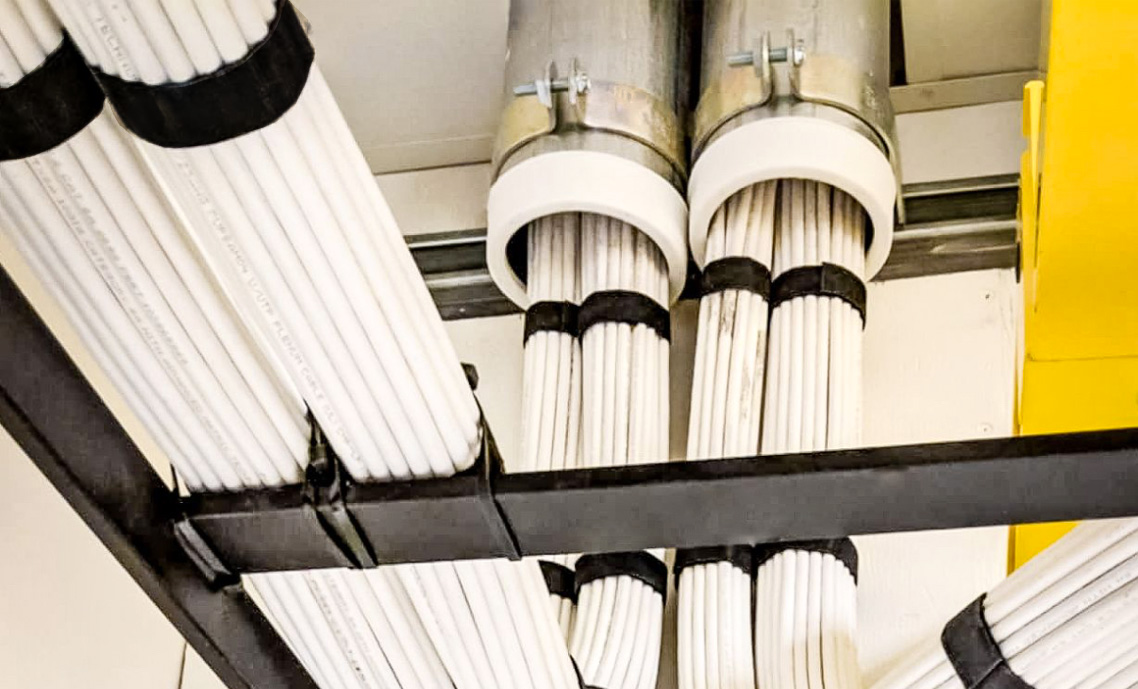
Smooth the Edge, Save Cable
Cable passing through metallic sleeves or field‑cut openings faces a unique set of mechanical risks that aren’t always obvious during installation. Sharp conduit edges, vibration, and routine cable movement can gradually wear through low‑voltage jackets, creating hidden failure points that may not surface until the system is disturbed or placed under load. Because these risks occur at the exact point where cable enters or exits a metallic surface, proper edge protection becomes a critical part of any compliant and durable installation.
With that foundation in place, the following sections explain when edge protection is required, which methods are acceptable, and how to avoid the common mistakes that lead to concealed cable damage.
Purpose & Code Requirements
1. When is edge protection required for low-voltage cable passing through metallic conduit or openings?
Edge protection is required any time low-voltage cable passes through a metallic raceway, sleeve, or field-cut opening where the cable jacket can contact a sharp metal edge. NEC 300.4(B), 300.4(C), and 300.4(F) all require conductors and cables to be protected from abrasion at metallic edges, and an insulating bushing or other listed insulating fitting must be used to provide that protection. Whenever cable is pulled through EMT, rigid conduit, or any metal penetration, the risk of jacket damage is present, and a smooth, insulated surface must be provided to prevent long-term abrasion or damage during future cable movement.
2. Does NEC require abrasion protection even if the cable is not electrical (e.g., data, security, telecom)?
Yes. NEC uses the broader term “conductors and cables,” which includes low-voltage wiring. The requirement is based on mechanical protection, not voltage level. Low-voltage cable jackets are typically thinner and more flexible than electrical insulation, making them more susceptible to damage when dragged across cut metal edges. As a result, the same abrasion-protection rules apply, and any metallic edge that can contact the cable must be treated to prevent damage.
3. Are insulating bushings acceptable in environmental air-handling (plenum) spaces?
Insulating bushings are acceptable in plenum spaces when they are identified for use in that environment and do not introduce prohibited combustible material. NEC 300.25(C) requires fittings installed in environmental air spaces to be suitable for the location and installed in a way that prevents conductor or cable damage. As long as the bushing is listed for raceway use and made from a material appropriate for air-handling spaces, it provides compliant protection and maintains the required smooth transition for cable entering or exiting a metallic sleeve.
4. Does NEC require bushings specifically for low-voltage cable the same way it does for 4 AWG and larger conductors?
NEC 300.4(G) applies only to 4 AWG and larger electrical conductors, so low-voltage cable is not covered by that specific bushing requirement. However, low-voltage installations are still subject to the general abrasion-protection rules in 300.4(B), 300.4(C), and 300.4(F), which require a smooth, insulated surface wherever cable passes through a metallic edge. The difference is that low-voltage cable does not trigger the large-conductor bushing rule, but it still must be protected from sharp metal in the same way. The requirement is based on preventing jacket damage, not on conductor size.
Acceptable Edge-Protection Methods
5. What types of edge-protection fittings are appropriate for low-voltage cable in EMT or rigid sleeves?
Any listed fitting or identified insulating material that provides a smooth, rounded surface at the end of a metallic raceway is acceptable. This includes snap-on insulating bushings for EMT, threaded insulating bushings for rigid or IMC, connectors with fully insulated throats, and insulating inserts that cover the entire circumference of the metal edge. The key requirement is that the fitting eliminates contact between the cable and any sharp metal surface, ensuring a safe and durable transition through the raceway.
6. Does the plastic throat inside a connector count as edge protection, or is a separate bushing still required?
A connector’s plastic throat can serve as edge protection if it fully covers the metal edge and provides a complete, smooth surface for the cable to pass through. However, many connectors have partial inserts, shallow lips, or exposed metal that still contacts the cable. In those cases, the connector does not provide adequate protection, and a separate bushing is required. The determining factor is simple: if any portion of the cable can touch bare metal at the raceway end, the connector alone is not sufficient.
7. When is edge protection not required for low-voltage cable?
Edge protection is not required when the cable passes through a non-metallic pathway or a factory-rolled smooth edge that does not present an abrasion hazard. Examples include PVC sleeves, ENT (smurf tube), listed cable trays with rolled edges, plastic J-hooks with integrated smooth surfaces, and openings that already include non-metallic bushings or grommets. If the cable never contacts a sharp metallic edge, additional protection is not required.
8. What temperature ratings apply to insulating bushings used for LV cable?
Insulating bushings must have a temperature rating at least equal to the cable insulation rating. Most listed insulating bushings are rated between 90°C and 105°C, which exceeds the temperature rating of typical datacom, security, and telecom cable jackets. This ensures that the bushing maintains its shape, stability, and protective function under normal operating conditions and does not deform or degrade over time.
Installation Conditions That Require Bushings
9. Do short EMT sleeves still require edge protection for low-voltage cable?
Yes. The length of the sleeve does not change the requirement. NEC focuses on the metallic edge itself, and even a short 2–4 inch EMT sleeve has a sharp cut edge capable of damaging cable jackets. During installation, future cable additions, or ceiling access, cable movement across that edge can cause abrasion. If the cable contacts the metal, edge protection is required regardless of sleeve length or sleeve purpose.
10. Are bushings required on both ends of a conduit sleeve used only as a protective pathway for LV cable?
Bushings are required on both ends if the cable passes through both edges and can contact the metal at each point. NEC 300.4(F) requires abrasion protection at the location where the cable enters or exits a raceway. If the sleeve is used strictly as a protective pathway and cable transitions through both ends, each end must provide a smooth, insulated surface. If cable only enters one end and does not exit the other, only the entry point requires protection.
Unacceptable or Improvised Methods
11. Are improvised materials like cardboard or tape acceptable as edge protection?
No. NEC requires identified or listed insulating fittings, and improvised materials such as cardboard, tape, cloth, or foam do not meet that requirement. These materials degrade, absorb moisture, shift out of place, and fail to provide reliable long-term protection. They also lack any listing or recognition for raceway use. Only properly identified bushings, insulated throats, or listed inserts provide compliant and durable edge protection.
12. What are the risks of leaving metallic sleeves or openings without bushings or edge protection for low-voltage cable?
When metallic sleeves or openings are left without insulating bushings or other listed edge‑protection fittings, the cable jacket can be cut, abraded, or worn down by the sharp metal edge during installation and over time. Low‑voltage cable jackets are thin and flexible, so even minor movement across an unprotected edge can cause damage that is difficult to see but can lead to intermittent faults, signal loss, or complete failure. NEC requires abrasion protection at metallic edges for this reason: an unprotected sleeve or opening creates a concealed damage point that may not be discovered until the cable fails or is disturbed during future work.
Proper edge protection ensures that low‑voltage cable transitions through metallic openings safely and consistently, supporting long‑term reliability and fully compliant installation practices.
The information provided in this FAQ is for general informational purposes only and is not intended to replace official codes, standards, or project specifications. Winnie Industries products must always be installed and used in accordance with our product instruction sheets or designated training. Products should never be applied beyond their intended purpose or in a manner that exceeds specified load ratings. Proper fastening is critical to system integrity and functionality, requiring secure attachment to structurally sound components capable of supporting imposed loads. All installations must comply with governing codes, regulations, and job site requirements. Always consult your Authority Having Jurisdiction (AHJ) for specific regulatory guidance.