

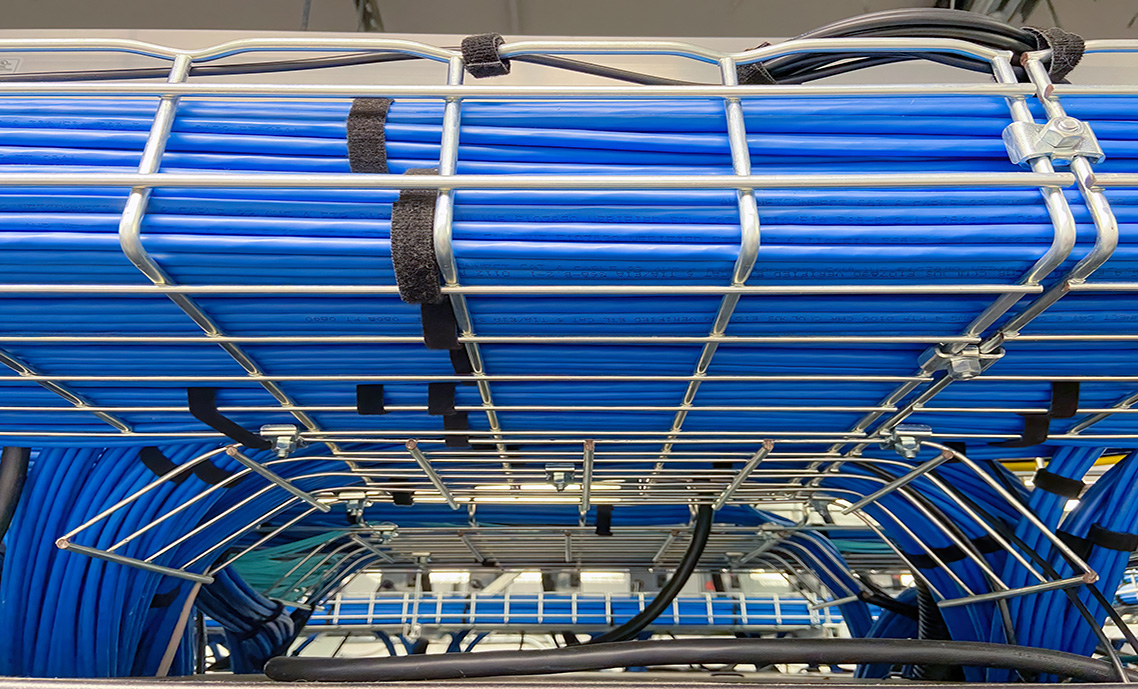
The Questions We Get Trayed On Most
Wire mesh cable tray shows up in more places than most people realize—above ceilings, along walls, inside data centers, and anywhere installers need a pathway that can adapt on the fly. Because it’s flexible, field‑modifiable, and built for the kind of cable density modern systems demand, it tends to spark a lot of “How do I…?” conversations. From grounding and bonding to bend radius, support spacing, and transitions, cable tray brings its own set of rules, best practices, and inspector‑approved details that every installer eventually needs to know.
To make those answers easier to find, we’ve organized the most common questions into clear sections you can jump through as needed.
Foundational Understanding
1. What is wire mesh cable tray and where is it used?
Wire mesh cable tray is a mechanical support system designed to route, organize, and protect low‑voltage and limited‑energy cabling across commercial and industrial spaces. Its open‑grid design provides ventilation, visibility, and easy field modification.
It is widely used in dense ceiling environments, technology rooms, open‑ceiling designs, and retrofit installations where pathways must adapt to changing cable needs and where accessibility is critical.
Wire mesh tray is chosen for its flexibility, ease of installation, and ability to be cut and shaped on‑site, making it ideal for modern IT‑heavy facilities and environments where cable density and future changes are expected.
2. What materials and finishes are available for wire mesh tray?
Wire mesh tray is manufactured in several metals and finishes to match environmental, structural, and corrosion‑resistance requirements. The material you choose directly affects load capacity, durability, and long‑term performance.
Common material and finish options include:
- Galvanized Steel – Strong, cost‑effective, suitable for most indoor spaces.
- Stainless Steel – High corrosion resistance for harsh or washdown environments.
- Aluminum – Lightweight, naturally corrosion‑resistant, easy to handle.
- Specialty Coatings – Epoxy, powder coat, or hot‑dip galvanizing for chemical or humid environments.
Selecting the correct material ensures the tray maintains structural integrity and protects cables throughout its service life.
3. Is wire mesh cable tray considered an electrical wiring method?
No. Wire mesh cable tray is not an electrical wiring method—it is a mechanical support system. The tray does not provide electrical protection, insulation, or enclosure.
Key points to understand:
- The cable type—not the tray—determines NEC compliance.
- Only cables listed and marked for tray use may be installed in cable tray.
- The tray cannot substitute for conduit, raceway, or equipment grounding conductors unless specifically listed.
Cable tray is the pathway; the cable is the wiring method.
4. What standards govern wire mesh tray installation?
Wire mesh cable tray is governed by standards that define construction, installation, and electrical compliance. These ensure safe installation and proper cable support.
The primary standards include:
- NEMA VE‑1 – Construction requirements for cable tray systems.
- NEMA VE‑2 – Installation guidelines for support spacing, fittings, grounding, and expansion.
- NEC Article 392 – Rules for allowable cable types, fill, routing, grounding, and plenum use.
Compliance requires following both NEMA installation practices and NEC electrical rules.
5. Does UL govern wire mesh cable tray or its components?
UL does not govern cable tray as a wiring method, but UL does govern several elements associated with tray systems. The tray itself is a mechanical support, but the cables and accessories used with it often carry UL listings.
UL listings apply to:
- Tray‑Rated Cables (TC, MC, PLTC, ITC, MV)
- Grounding Hardware and Bonding Accessories
- Splice Plates and Structural Accessories
- UL 2043‑Rated Components for Plenum Spaces
Structural design and installation requirements remain under NEMA VE‑1 and VE‑2.
Cable Ratings, Compatibility, and Environmental Use
6. What cable types can wire mesh tray support?
Wire mesh tray supports a wide range of low‑voltage and limited‑energy cabling, provided the cable itself is listed for tray use. The tray offers mechanical support, but the cable must meet NEC requirements for insulation, flame rating, and application.
Common cable types include:
- Structured Cabling (Cat 5e/6/6A/7)
- Fiber Optic Cable
- PoE and Extended‑Distance Cabling
- Coaxial Cable
- Fire Alarm, Security, and Access Control Wiring
- Audio/Video and Control Wiring
- Instrumentation and Signal Cable
- Innerduct and Microduct
Maintain separation between limited‑energy and higher‑voltage circuits per NEC 2026.
7. Can wire mesh tray be used in plenum spaces?
Yes. Wire mesh tray is commonly installed in plenum spaces, but all components must meet NEC 300.22(C) requirements. The open‑grid design allows airflow, but accessories and hardware must also be plenum‑compliant.
Key considerations include:
- Use UL 2043‑Rated Accessories
- Ensure Cables Are Plenum‑Rated (CMP, OFNP, etc.)
- Maintain Clearance from HVAC Equipment
- Avoid Non‑Rated Components in Air‑Handling Zones
Always confirm with the AHJ before installation.
Installation Requirements and Structural Best Practices
8. What support spacing is required for wire mesh tray?
Support spacing is critical because wire mesh tray will deflect under load, and excessive deflection can compress cable bundles, deform the tray, and violate NEC 392. NEMA VE‑2 requires supports often enough to maintain structural integrity and prevent sagging.
Typical support spacing guidelines include:
- 4–6 Feet for Standard Loads
- 3–4 Feet for Wider Trays or Heavier Bundles
- Supports at Every Directional Change
- Supports at Every Transition (to J Hooks, Conduit, or Equipment)
Shorter spacing reduces deflection, protects cable geometry, and ensures long‑term performance.
9. How do you calculate and manage cable load in wire mesh tray?
Proper load calculation ensures the tray can safely support all installed cables without deformation. Overloading is a common field mistake that leads to sagging, twisting, and long‑term cable damage.
Load calculation steps include:
- Determine Cable Weight Per Foot
- Multiply by the Number of Cables
- Apply the Correct Support Spacing
- Compare to the Tray’s Allowable Working Load
- Document Calculations for Inspection
Exceeding load ratings can deform the tray, compress cable jackets, and create performance issues—especially for PoE and fiber.
10. How should wire mesh tray be cut and modified in the field?
Wire mesh tray is designed for field modification, but it must be cut and shaped correctly to maintain structural integrity and protect cables. Improper cutting or bending can create sharp edges, hinge points, and weak sections.
Best practices include:
- Use Proper Cutting Tools
- Remove Burrs and Sharp Edges
- Install Protective Edging at Cut Points
- Avoid Unsupported Hinge Sections
- Support All Transitions per NEMA VE‑2
Improper field‑fabricated bends are a leading cause of cable jacket damage.
11. What fittings are used with wire mesh tray?
Wire mesh tray uses both field‑fabricated and manufacturer‑provided fittings to create directional changes and transitions. While field fabrication is allowed, it must be done correctly to maintain structural strength and cable protection.
Common fittings include:
- Horizontal Bends
- Vertical Bends (Up/Down)
- Tees
- Crosses
- Offsets
- Reducers
- Drop‑Outs and Waterfalls
All fittings must maintain bend radius, structural integrity, and grounding continuity.
12. How should fittings be supported to maintain structural integrity?
Fittings introduce mechanical stress because they change direction, redistribute load, and create leverage points. Unsupported fittings can twist, sag, or pull adjacent tray sections out of alignment.
Support requirements include:
- Supports Before and After Every Fitting
- Supports at All Vertical Transitions
- Supports at Tees and Crosses
- Supports at Reducers and Drop‑Outs
Proper support prevents torsion, maintains alignment, and ensures long‑term stability.
13. How do you maintain proper bend radius when exiting or entering the tray?
Maintaining bend radius prevents signal loss, fiber damage, and conductor stress. Wire mesh tray must use rated accessories or smooth transitions to guide cables safely.
Best practices include:
- Use Drop‑Outs, Waterfalls, or Radius Control Fittings
- Avoid Sharp Edges or Abrupt Directional Changes
- Support Cables Immediately After Exiting the Tray
- Follow Cable‑Specific Bend Radius Requirements
Improper bend radius is one of the most common causes of performance issues.
Fittings, Transitions, and Pathway Integration
14. How do you transition from wire mesh tray to j hook support?
A proper transition protects cable bend radius and prevents mechanical stress as cables leave the tray. Unsupported drops are a common mistake that lead to jacket damage and signal issues.
Recommended transition steps include:
- Install a Drop‑Out or Radius Fitting at the Tray Edge
- Support the Transition with J Hooks Spaced per TIA‑569
- Size J Hooks Correctly for the Cable Bundle
- Maintain Separation Between Limited‑Energy and Higher‑Voltage Circuits
Proper transitions protect cable geometry and simplify future maintenance.
15. How do you transition from wire mesh tray to conduit?
Tray‑to‑conduit transitions must protect cable jackets, maintain bend radius, and ensure grounding continuity. Abrupt or unsupported transitions can cause abrasion and long‑term cable damage.
Best practices include:
- Use a Tray‑to‑Conduit Adapter or Protective Bushing
- Support the Conduit Within 3 Feet of the Transition
- Bond the Tray and Conduit if Required
- Maintain Cable Bend Radius Throughout the Transition
Proper transitions ensure mechanical protection and electrical continuity.
16. How do you protect cables from abrasion at tray edges and drop‑outs?
Abrasion protection is essential to prevent jacket damage, especially at cut edges, transitions, and drop‑outs. Sharp edges can compromise cable performance and violate NEC requirements.
Protection methods include:
- Install Protective Edging or Grommets
- Use Drop‑Outs or Waterfall Fittings
- Remove Burrs After Cutting
- Support Cables Immediately After Exiting the Tray
Proper abrasion protection extends cable life and reduces maintenance issues.
Grounding, Bonding, Expansion, and System Continuity
17. Do wire mesh trays need to be grounded and bonded?
Yes. Wire mesh tray must be bonded and grounded according to NEC 392 and NEMA VE‑2. The tray is conductive, and continuity must be maintained across all sections and fittings to ensure electrical safety.
Grounding and bonding requirements include:
- Use Listed Bonding Jumpers or Grounding Splice Plates
- Ensure Continuity Across Field‑Fabricated Fittings
- Bond the Tray to the Building Grounding Electrode System
- Verify All Hardware Is Tight and Corrosion‑Free
Proper grounding protects personnel and equipment from fault currents and static discharge.
18. How do you handle thermal expansion and contraction in wire mesh tray?
Wire mesh tray expands and contracts with temperature changes, especially in long runs or environments with large thermal swings. Without expansion control, trays can warp, shear splice plates, or stress cables.
Expansion management includes:
- Establishing Fixed Points to Anchor the Run
- Using Expansion Splice Plates Where Required
- Setting Manufacturer‑Specified Installation Gaps
- Allowing Movement in the Direction of Thermal Travel
Expansion control protects both the tray and the cables it supports over the life of the system.
19. How do you establish fixed points and expansion points?
Fixed and expansion points work together to control how the tray moves as temperatures change. A fixed point locks the tray in place, while expansion points allow it to grow or shrink safely.
Best practices include:
- Place at Least One Fixed Point per Run
- Anchor Fixed Points Rigidly to Structure
- Locate Expansion Points Based on Material Type and Run Length
- Use Rated Expansion Splice Plates
- Set the Correct Installation Gap
This ensures predictable movement and prevents stress on cables and hardware.
20. What clearances are required around mechanical, fire protection, and HVAC systems?
Wire mesh tray must be routed to avoid conflicts with mechanical systems, fire protection equipment, and HVAC components. Improper routing can violate code, obstruct maintenance, or create safety hazards.
Clearance considerations include:
- Maintain Required Clearance from Sprinkler Heads
- Avoid Blocking Access Panels or Service Areas
- Stay Clear of Ductwork and Airflow Paths
- Follow Local AHJ Requirements for Fire Protection Zones
Proper routing ensures compliance and prevents conflicts with other building systems.
21. What are the most common installation mistakes with wire mesh tray?
Several recurring mistakes can compromise cable performance, violate code, or reduce system lifespan. Recognizing these issues helps ensure a compliant and reliable installation.
Common mistakes include:
- Overspanning Supports, Leading to Excessive Deflection
- Improper or Unsupported Field‑Fabricated Bends
- Missing Abrasion Protection at Cut Edges
- Overfilling the Tray Beyond NEC Allowable Fill
- Failing to Bond and Ground the Tray System
Avoiding these mistakes improves safety, performance, and long‑term reliability.
22. How do you ensure compliance with NEC 392 during installation?
NEC 392 governs cable tray installation, cable types, fill limits, grounding, and routing. Compliance requires understanding both the electrical and mechanical aspects of the system.
Key compliance steps include:
- Use Only Tray‑Rated Cables
- Follow Allowable Fill and Cable Spacing Requirements
- Maintain Proper Support Spacing
- Bond and Ground All Tray Sections
- Protect Cables from Abrasion and Sharp Edges
Documenting installation details helps streamline inspection and approval.
23. When should you choose wire mesh tray over other cable support methods?
Wire mesh tray is ideal when flexibility, accessibility, and rapid field modification are priorities. It excels in environments where cable density is high and future changes are expected.
Wire mesh tray is preferred when:
- Frequent Moves, Adds, and Changes Are Expected
- Open‑Ceiling or Tech‑Heavy Environments Are Used
- Large Bundles of Low‑Voltage Cabling Must Be Supported
- Field‑Fabricated Bends and Custom Routing Are Required
- Visibility and Accessibility Are Important for Maintenance
Choosing wire mesh tray provides long‑term adaptability and simplifies cable management in evolving facilities.
Together, these insights give you everything you need to build cable tray systems that stay solid, safe, and inspector‑ready.
The information provided in this FAQ is for general informational purposes only and is not intended to replace official codes, standards, or project specifications. Winnie Industries products must always be installed and used in accordance with our product instruction sheets or designated training. Products should never be applied beyond their intended purpose or in a manner that exceeds specified load ratings. Proper fastening is critical to system integrity and functionality, requiring secure attachment to structurally sound components capable of supporting imposed loads. All installations must comply with governing codes, regulations, and job site requirements. Always consult your Authority Having Jurisdiction (AHJ) for specific regulatory guidance.