

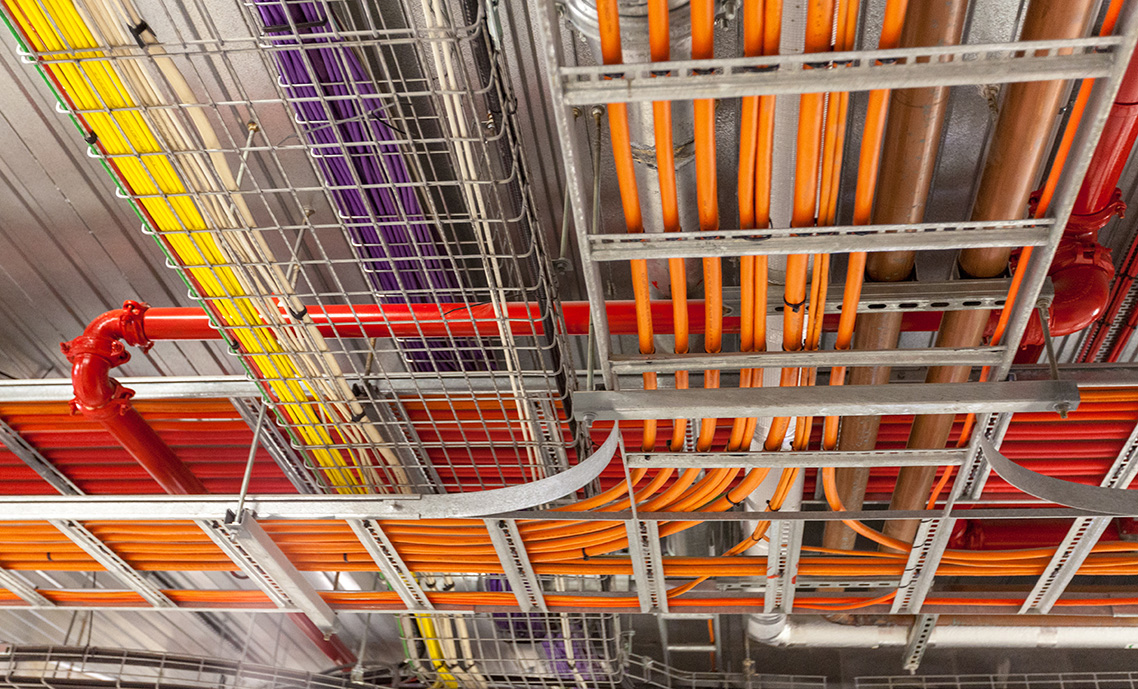
This Pathway Doesn’t Share
Dedicated pathways anchor the reliability of life‑safety and limited‑energy systems by keeping each system’s wiring physically separated, clearly identified, and protected from interference. This separation prevents cross‑system congestion, accidental damage, and misrouting, ensuring that critical functions remain traceable and dependable when conditions are most demanding. Whether supporting fire alarm, smoke control, nurse call, access control, or emergency communication, a dedicated pathway provides an organized, uninterrupted route that strengthens system survivability and simplifies inspection. In both retrofit and new construction, dedicated pathways remain a non‑negotiable element of performance, clarity, and life‑safety continuity.
The following sections outline how dedicated pathways support the organization, separation, and survivability of life‑safety and limited‑energy systems across a building.
1. Define a Dedicated Cable Pathway
A dedicated cable pathway is a physically separated, clearly identified route used to support and organize wiring for a single system. Unlike electrical branch circuits, which deal with breakers and loads, dedicated pathways focus on routing, separation, survivability, and identification of limited-energy and life-safety cabling.
Dedicated pathways help ensure that critical systems remain:
- Easy to identify
- Easy to inspect
- Easy to troubleshoot
- Physically separated from unrelated systems
- Compliant with survivability and routing requirements
They are essential for fire alarm, nurse call, access control, mass notification, smoke control, and other life-safety systems.
2. Understand Why Dedicated Pathways Matter
Life-safety and limited-energy systems must remain functional and identifiable during emergencies. When these systems share supports with unrelated cabling, it becomes harder to inspect, harder to maintain, and easier to misroute or damage critical circuits.
Dedicated pathways:
- Prevent cross-system bundling
- Reduce installation errors and rework
- Improve AHJ approval
- Support survivability requirements
- Maintain system integrity during fire conditions
- Provide visual clarity across the jobsite
As more building systems migrate to limited-energy architectures, pathway discipline becomes increasingly important.
3. Identify Systems That Require or Benefit From Dedicated Pathways
Fire & Life Safety Systems
Fire and life-safety systems must remain operational during emergencies. Their wiring supports detection, notification, control, and emergency communication functions. Because these circuits interact directly with fire alarm equipment and emergency control logic, they require strict separation and clear identification.
Systems include:
- Fire alarm (SLC, NAC, power-limited)
- Fire alarm auxiliary and control circuits
- Smoke control control wiring
- Firefighter telephone
- Area of refuge communication
- Elevator recall control
- Elevator shunt-trip control
- Mass notification (MNS)
- Emergency voice/alarm communication (EVACS)
- Fire pump supervisory and control wiring
- Fire command center communication circuits
Suggested pathway color: Red
Healthcare & Medical Signaling
Healthcare facilities rely on signaling systems that support patient safety, staff communication, and emergency response. These systems often run through sensitive clinical areas and must remain organized, isolated, and easy to trace during maintenance or upgrades.
Systems include:
- Nurse call
- Code blue
- Medical gas alarm wiring
- Patient monitoring
- Wander management
- Infant protection systems
- Nurse station trunk lines
- Healthcare intercom and paging
Suggested pathway color: Yellow
Security & Access Control
Security and access control systems must remain isolated to maintain system integrity and prevent cross-interference. These pathways often run through secure areas, door frames, and equipment rooms where clarity and separation are essential for troubleshooting and compliance.
Systems include:
- Access control (card readers, strikes, maglocks)
- Security panel home runs
- REX sensors
- Door position switches
- CCTV camera home runs
- Security intercom
- Intrusion detection
Suggested pathway color: Blue or White
Emergency Communication & Public Safety Radio Systems
Emergency communication systems ensure that first responders can communicate during fire or disaster events. These systems often require survivability, protected routing, and clear separation from all other cabling.
Systems include:
- Public safety DAS / BDA systems
- Emergency responder radio coverage systems (ERRCS)
- BDA backbone cabling
- Donor antenna coax or fiber
- Head-end to remote unit cabling
Suggested pathway color: Orange or Red (AHJ-dependent)
Communications & IT Systems
Communications and IT pathways support building operations, occupant communication, and network infrastructure. While not life-safety, many facilities isolate these pathways to maintain performance, reduce congestion, and simplify future expansion.
Systems include:
- Paging
- Intercom
- VoIP backbone
- PoE device home runs
- Fiber backbone (IDF to MDF)
- DAS (non-public safety)
- Building automation networks
- AV control networks
Suggested pathway color: Blue or White
Building Automation & Control Systems
Building automation systems manage HVAC, lighting, energy, and environmental controls. These pathways often run through mechanical spaces and require clear separation to avoid interference and maintain emergency override clarity.
Systems include:
- HVAC control wiring
- VFD control circuits
- Damper control wiring
- BAS network cabling
- Lighting control networks
- Emergency override logic
- Generator monitoring circuits
- Transfer switch control wiring
Suggested pathway color: Gray or White
4. Apply NEC 2026 Updates to Pathway Design
NEC 2026 reorganizes and clarifies the rules that affect limited-energy pathway design.
Key changes:
- “Low-voltage” is replaced with Limited Energy (LE) terminology
- Legacy Article 800 content is now distributed across 725, 760, 770, 805, and 820
- Separation rules for LE systems are clarified
- Fire alarm survivability references align more closely with NFPA 72
- Communications, fiber, and power-limited circuits now have clearer boundaries
- AHJs increasingly expect system-specific pathway identification
- Mixed-system bundling is more explicitly discouraged
Class 2 Circuit and Class 3 Circuit separation requirements are reinforced under NEC 725. Dedicated pathways help maintain these requirements and simplify inspection.
5. Apply Best Practices for Dedicated Pathways
Identification
- Use consistent color coding
- Label pathway start and end points
- Maintain system-specific hardware throughout the run
- Match pathway color to system type
Separation
- Do not mix systems in the same support
- Maintain spacing from high-voltage circuits
- Follow LE separation rules (NEC 725, 760, 770, 805, 820)
- Keep fire alarm pathways isolated from all other systems
Routing Discipline
- Use straight, predictable routes
- Avoid unnecessary transitions
- Maintain headroom and clearance
- Keep pathways accessible for inspection
6. Use the Correct Cable Management Components
Dedicated pathways rely on the correct mechanical supports. Below is a comprehensive list of cable-management components used across the industry. This includes both standard fastening methods and painted hardware used for system identification.
- J Hooks
- Painted J Hooks
- Bridle Rings
- Painted Bridle Rings
- Conduit (EMT, Rigid, IMC)
- Conduit Clamps
- Surface Raceway
- Cable Tray (Ladder, Basket, Solid Bottom)
- Fire-Rated Cable Tray
- MI Cable Supports
- Strut Clamps
- Beam Clamps
- Seismic-Rated Fasteners
- ID Rings
- Cable Tags
- Cable Ties (Plenum-Rated, UV-Rated)
- Raceway Supports
- Fiber Innerduct
- Raceway Dividers
Painted supports are widely used to visually identify dedicated pathways for fire alarm, nurse call, security, and communications systems. While not a code requirement, they simplify inspection, reduce installation errors, and create consistent visual organization across the jobsite.
7. Reference the Glossary for Key Pathway Terms
- AHJ — Authority Having Jurisdiction
- Class 2 Circuit — A power-limited circuit defined by NEC 725 with inherent shock and fire protection
- Class 3 Circuit — A higher-capacity power-limited circuit defined by NEC 725 with additional separation requirements
- Dedicated Pathway — A cable route reserved for one system
- Limited Energy (LE) — NEC term replacing “low-voltage”
- Protected Pathway — A fire-rated or otherwise protected route
- Survivability — Ability of a circuit to function during fire conditions
- System Identification — Visual marking of cable pathways
When pathways stay dedicated, systems stay clear, traceable, and ready to perform when it matters.
This guide is intended for informational and reference purposes only. It does not supersede local codes, manufacturer specifications, or the judgment of the Authority Having Jurisdiction (AHJ). Installation practices must always be verified against current NEC, ANSI/TIA standards, and site-specific requirements. Winnie Industries products must be installed and used in accordance with official instruction sheets or designated training. Products should never be applied beyond their intended purpose or in a manner that exceeds specified load ratings. Proper fastening is critical to system integrity and functionality, requiring secure attachment to structurally sound components capable of supporting imposed loads. All installations must comply with governing codes, regulations, and job site requirements. Always consult your AHJ for specific regulatory guidance.